
Google introduced WebMCP to allow AI agents to execute structured actions directly on websites, not just crawl them. The internet is undergoing its most significant architectural shift since the advent of the smartphone. For decades, websites were built exclusively for human eyes, places where we clicked, scrolled, and typed. According to recent analysis by industry experts, AI agents that rely on traditional screen scraping or DOM manipulation can waste up to 89% of their token budget simply by parsing visual layouts and button placements rather than processing actual information. This massive inefficiency is the problem that WebMCP is designed to solve. If you are a business owner, developer, or SEO professional, understanding this technology is no longer optional; it is the key to visibility in the next generation of search.
Welcome to the ultimate guide to Google’s WebMCP, the future of SEO. We will explore what is WebMCP, how it contrasts with existing standards, and exactly how you can prepare your digital strategy for the rise of AI agents.
What is WebMCP? A New Language for Machines
To truly grasp the future, we must first answer the fundamental question: What is WebMCP? Simply explained, Google WebMCP is a new, open protocol (Web Model Context Protocol) developed jointly by engineers at Google and Microsoft. It acts as a bridge between your website and AI agents running in the browser.
Traditionally, if an AI assistant wanted to book a flight for you, it had to “look” at the screen, identify the “From” and “To” fields, and simulate typing, a process prone to error if a website layout changed. With WebMCP, the website can directly tell the AI, “Here are my functions: searchFlights(date, destination) and bookFlight(flightId).” The AI simply calls the function. As noted by a Google engineer, WebMCP aims to become the “USB-C” for AI applications, a universal connector that standardizes how agents interact with web services.
You can also read our Top 9 Website Design Mistakes That Kill Conversions that helps you to make the website user-friendly for both mobile and desktop.
Google WebMCP vs Core Web Vitals: A New SEO Paradigm
For years, technical SEO has been dominated by the need to optimize Google WebMCP vs Core Web Vitals. While Core Web Vitals measure the experience of a human user (loading speed, interactivity, visual stability), WebMCP measures the executability of a site for a machine.
This marks a fundamental shift. Core Web Vitals ask, “Is this site pleasant for a person to use?” WebMCP asks, “Is this site easy for an AI to use?” In the future, a site that loads quickly but forces an AI to “hunt and peck” for buttons will be less efficient for agentic search than a slightly slower site that offers clear, structured AI tools. This is why understanding how Google Webmcp works is becoming just as critical as optimizing for page speed.
How Google Webmcp Works: The Technical Breakdown
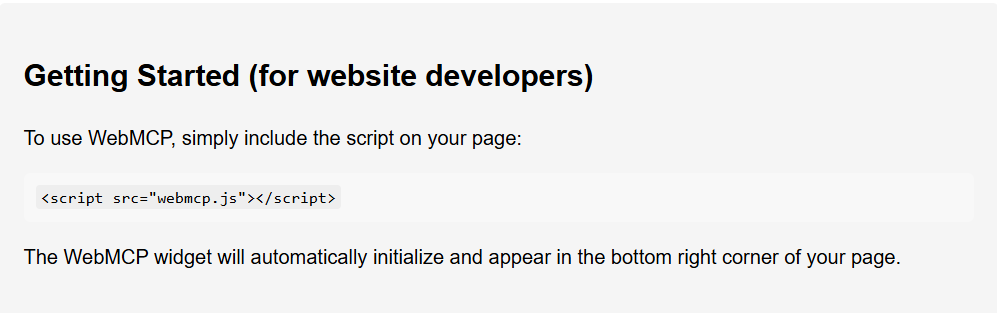
Understanding how Google Webmcp works is simpler than it sounds. It introduces a new browser API called navigator.modelContext. Developers can expose their site’s functionality in two primary ways:
The Declarative Approach: This is the easiest way to get started. You add specific attributes directly to your HTML forms. For example, a search form might get the attribute toolname=”searchProducts” and a tooldescription=”Searches the product catalog by keyword”. The browser then automatically generates a “contract” for the AI to read.
The Imperative Approach: For more complex interactions, developers can use JavaScript to register custom functions. This allows for multi-step processes, like checking out a shopping cart, to be executed by an AI with a single call.
How llms read websites is changing because of this. Instead of reading words on a screen, LLMs will soon be reading function lists. This transforms a website from a static document into a dynamic, callable application.
How Webmcp Changes SEO: From Content to Capability
The most profound impact of this technology is how WebMCP changes seo. SEO is no longer just about keywords and backlinks; it is about “capability indexing.” Search engines will soon index not just what a page says, but what a page can do.
Imagine a user asking their AI assistant, “Find me a red dress under $50 that can be delivered by tomorrow, and buy it.” The AI will scan the web, not for pages that mention “red dress,” but for sites with a WebMCP tool that matches the query: filterProducts(color, priceRange) and expressCheckout(itemId). If your e-commerce site hasn’t exposed these tools via WebMCP, the AI literally cannot see your “buy button.” You become invisible to the machine-driven economy. This shift is why many experts believe that ” Is WebMCP the future of SEO is a rhetorical question; the answer is a definitive yes.
Our SEO services at Web Marlins are already evolving to help businesses navigate this shift and stay ahead of competitors who are still operating on an outdated SEO playbook.
How to Rank in AI Search Engine Using WebMCP
So, how to rank in Ai search engine using WebMCP? It requires a proactive approach. It’s not enough to have great content; you need to have great tools.
Audit Your User Flows: Identify the key actions users take on your site. Is it booking a consultation? Making a purchase? Checking an order status? These are the functions you need to expose.
Implement Declarative Markup: Start by adding the toolname and tool description attributes to your most important forms.
Build an “Agent Layer”: For complex sites, consider developing a dedicated JavaScript layer that registers imperative tools. This tells AI agents exactly how to interact with your core services.
At Web Marlins, we specialize in future-proofing digital strategies. If you are looking to build a robust online presence that caters to both humans and machines, explore our comprehensive Web Development Services to ensure your site’s architecture is ready for the agentic web.
For guidance on building a complete AI-era SEO strategy, connect with the digital marketing experts.
Webmcp SEO Checklist: Preparing for the Agentic Web
Use this WebMCP SEO checklist to assess and improve your site’s readiness for the agentic web in 2026.
- ✅ Audit all key transactional actions on your website (book, buy, search, filter, subscribe, contact)
- ✅ Sign up for Google’s WebMCP Early Preview Program via the Chrome Developer portal
- ✅ Implement the Declarative API for form-based, predictable interactions
- ✅ Implement the Imperative API for multi-step, JavaScript-driven workflows
- ✅ Write named, parameter-rich Tool Contracts for each core action
- ✅ Combine WebMCP implementation with Schema.org structured data markup
- ✅ Ensure your site’s authentication flows are agent-compatible (no CAPTCHA blocking legitimate agents)
- ✅ Test all Tool Contract functions in a staging environment before going live
- ✅ Monitor AI-referred traffic and agent interaction data via Search Console
- ✅ Build a parallel GEO (Generative Engine Optimization) strategy for AI citation visibility
Just as you would maintain a technical SEO audit, maintaining this capability layer is crucial. For ongoing management and content strategy that aligns with these new standards, check out our insights on Effective Digital Marketing Strategies to integrate WebMCP into your broader marketing mix.
How Web Marlins Helps You Implement WebMCP on Your Website
Understanding WebMCP is one thing. Actually implementing it correctly on your live website without breaking your existing user experience, SEO performance, or backend workflows is a completely different challenge. That’s exactly where Web Marlins comes in.
We are a full-service digital marketing agency based in South Delhi with in-house expertise spanning SEO, web development, content, and technical strategy. When it comes to WebMCP, we don’t hand you a checklist and wish you luck. We build and execute the entire implementation plan for you from audit to go-live.
Here is exactly what our team does at every stage of the process:
1. WebMCP Site Audit — Finding Your “Action Opportunities” Before writing a single line of code, our SEO and development teams run a full audit of your website to map every transactional action your users take — booking, buying, filtering, subscribing, contacting, searching. We identify which of those actions are highest priority for AI agents to access and which are most likely to drive agentic conversions for your business. This audit becomes the blueprint for your Tool Contract.
2. Tool Contract Design and Development Our web development team designs and codes your WebMCP Tool Contracts from the ground up — with descriptive function names, clean parameters, and structured outputs that are optimized for agent readability. We implement the Declarative API for your standard form-based interactions and the Imperative API for complex multi-step flows like checkout, booking, or dynamic search — ensuring both are agent-compatible and future-proof.
3. Integration With Existing SEO and Structured Data We don’t implement WebMCP in isolation. Our SEO specialists layer your Tool Contracts on top of your existing Schema.org structured data and on-page SEO strategy — so AI agents get both a clear picture of what your site is and what it can do. This combined approach maximizes your visibility across traditional Google search, AI Overviews, and agentic search queries simultaneously.
4. GEO (Generative Engine Optimization) Content Strategy Getting AI agents to transact on your site is only half the battle. Getting AI models to cite and recommend your business in their answers is the other half. Our content writing services build a parallel GEO strategy — creating authoritative, AI-citable content that positions your brand as the trusted answer for your most valuable queries, while WebMCP ensures agents can act on that trust instantly.
5. Testing, Monitoring, and Ongoing Optimisation After implementation, our team tests every Tool Contract function in a staging environment before going live. Post-launch, we monitor AI-referred traffic, agent interaction data, and conversion performance through Search Console and third-party analytics — and we continuously refine your Tool Contracts as the WebMCP standard evolves and Google expands its Early Preview into a full rollout.
The bottom line: WebMCP implementation is not a one-time task. It is an ongoing technical SEO discipline, and having an experienced agency partner in your corner from day one makes the difference between leading the agentic web and chasing it.
Ready to make your website agent-ready before your competitors do? Get a free WebMCP consultation with the Webmarlins team today.
The Future is Collaborative
The future of the web is not human-only or AI-only; it is collaborative. WebMCP enables a “shared UI” where humans and agents work side-by-side. You might browse a travel site visually, enjoying the photos, while your AI agent, using the site’s WebMCP tools, simultaneously fills out the passenger details in the background.
Google WebMCP Guide resources like this one are emerging because the industry recognizes that we are building a new digital habitat. It’s a world where your website must be beautiful to the human eye and perfectly structured for the machine mind.
Conclusion
WebMCP is not just another tech update; it is the infrastructure for the next era of the internet. By moving from a web of documents to a web of functions, it promises to make AI assistants infinitely more useful and reliable. For businesses, the message is clear: start learning what is WebMCP today, audit your site’s capabilities, and prepare to be indexed not just by keywords, but by the very things you can do for your customers. The future of SEO is execution, and WebMCP is the engine that will power it.
Frequently Asked Questions (FAQs)
1. What is WebMCP in simple terms?
WebMCP (Web Model Context Protocol) is a new standard that allows websites to tell AI agents exactly what functions they can perform (like “book a flight” or “buy a product”), so the AI doesn’t have to guess by looking at the screen.
2. How is WebMCP different from a regular API?
While a regular API is a private line for developers, WebMCP is a public, standardized way for any authorized AI agent in the browser to understand and interact with a website’s frontend functions.
3. Is WebMCP the future of SEO?
Yes. WebMCP shifts SEO from optimizing for keywords to optimizing for “actions.” In the future, search engines may prioritize sites that offer clear, executable tools for AI agents, making it a cornerstone of SEO strategy.
4. How does WebMCP affect Core Web Vitals?
They are complementary. Core Web Vitals measure the user experience, while WebMCP measures the “agent experience.” A site will need to excel at both to be fully competitive.
5. How do large language models read websites with WebMCP?
Instead of parsing HTML text, LLMs read the “Tool Contract” provided by WebMCP. They see a list of available functions (e.g., searchHotel), their required inputs (e.g., location, dates), and call them directly.
6. Do I need to be a coder to implement WebMCP?
Basic implementation can be done by adding HTML attributes to existing forms, which is accessible to anyone who manages a CMS. However, complex interactions may require developer assistance.
7. What is the WebMCP SEO checklist for a small business?
Start by identifying the key actions on your site (contact forms, booking buttons), ensure they are proper HTML forms, and add the toolname and tooldescription attributes to them.
8. How does WebMCP handle user privacy and login?
WebMCP works within the browser and reuses existing user sessions. If a user is logged into a site, the AI agent can perform actions using that same authenticated session without asking for passwords again.
9. When will WebMCP be widely available?
It is currently in early preview in Chrome Canary. If it gains final approval and support from other major browsers (like Safari and Firefox), we can expect wider adoption throughout 2026 and 2027.
10. Where can I find the official WebMCP documentation?
You can find the open-source project and discussions on the official GitHub repository maintained by the Web Machine Learning Community Group. For practical implementation guides, following industry-leading tech blogs like those linked in this article is highly recommended.