
Updated: August 3, 2026
Short answer: Web 2.0 properties still work, but almost none of them work the way the 2015-era tutorials say they do. Mass-creating twenty Tumblr and Weebly blogs to point exact-match anchors at your money page is now a documented spam pattern that Google’s systems ignore at best and flag at worst. A small number of genuinely maintained Web 2.0 properties, publishing real content on platforms your audience actually reads, still earn traffic, brand signals, and occasional link value.
What is Web 2.0 in SEO?
Web 2.0 in SEO refers to publishing content on third-party platforms that let anyone create a page or subdomain — Blogger, WordPress.com, Medium, Tumblr, Substack, Weebly — in order to build brand presence, referral traffic, and links back to your own site. The term dates to the mid-2000s shift from static, read-only websites to platforms built around user-generated content, comments, and sharing.
In practical SEO terms, a “Web 2.0” is any hosted property you control the content of but not the domain. Your yourbrand.blogspot.com blog is a Web 2.0 property. Medium publication is a Web 2.0 property. Your company’s own WordPress install on your own domain is not.
The distinction matters because everything that follows — link attributes, indexation, risk — depends on the fact that you are a guest on someone else’s domain.
What are Web 2.0 backlinks?
Web 2.0 backlinks are links pointing to your website from content you published yourself on a third-party publishing platform. Because you create both the content and the link, they are self-made links, not editorially earned ones — and Google’s ranking systems treat those two categories very differently.
Three things determine whether a Web 2.0 backlink has any value:
- The link attribute. Most major platforms apply
rel="nofollow"orrel="ugc"to outbound links automatically. Since 2019, Google treats these as hints rather than strict directives, meaning value may pass — but you cannot count on it. - Whether the page is indexed. A Web 2.0 post that Google never indexes passes nothing at all, regardless of the platform’s domain authority. This is the single most common reason Web 2.0 campaigns produce zero measurable lift.
- Whether the content is real. Google’s spam policies explicitly cover scaled content abuse and site reputation abuse. Thin, spun, or AI-mass-produced posts on a high-DA platform are exactly the footprint those policies were written to catch.
Do Web 2.0 backlinks still work in 2026? An honest verdict
Here is the line, stated plainly:
| Approach | Does it work in 2026? | Why |
|---|---|---|
| Building 10–50 Web 2.0 blogs with spun content and exact-match anchors | No — and it’s a documented risk | Matches Google’s link spam and scaled content abuse patterns; links are typically discounted before they ever count |
| Buying “50 high-DA Web 2.0 backlinks” from a marketplace | No | Same footprint, plus you don’t control indexation or longevity |
| Running 1–3 genuinely maintained brand properties with original content | Yes, modestly | Earns referral traffic, brand mentions, and entity signals; occasionally earns real editorial links to the property itself |
| Publishing on a platform where your audience already reads (Substack, Medium, a niche community) | Yes | Traffic and brand value are the return; treat any link value as a bonus |
Google’s Search Central spam policies list “large-scale article marketing or guest posting campaigns” and “low-quality directory or bookmark site links” among link spam examples. Mass Web 2.0 creation sits squarely inside that description, and Google’s own John Mueller has described the tactic in similar terms for years.
The honest framing: Web 2.0 properties are a brand and distribution channel that sometimes produces link value. They are not a link-building channel. Teams that get results from them are the ones who stopped counting links and started counting readers.
Are Web 2.0 links dofollow or nofollow?
This is the most common question we get, and most published lists are wrong or out of date. Verify before you build — attributes change without announcement.
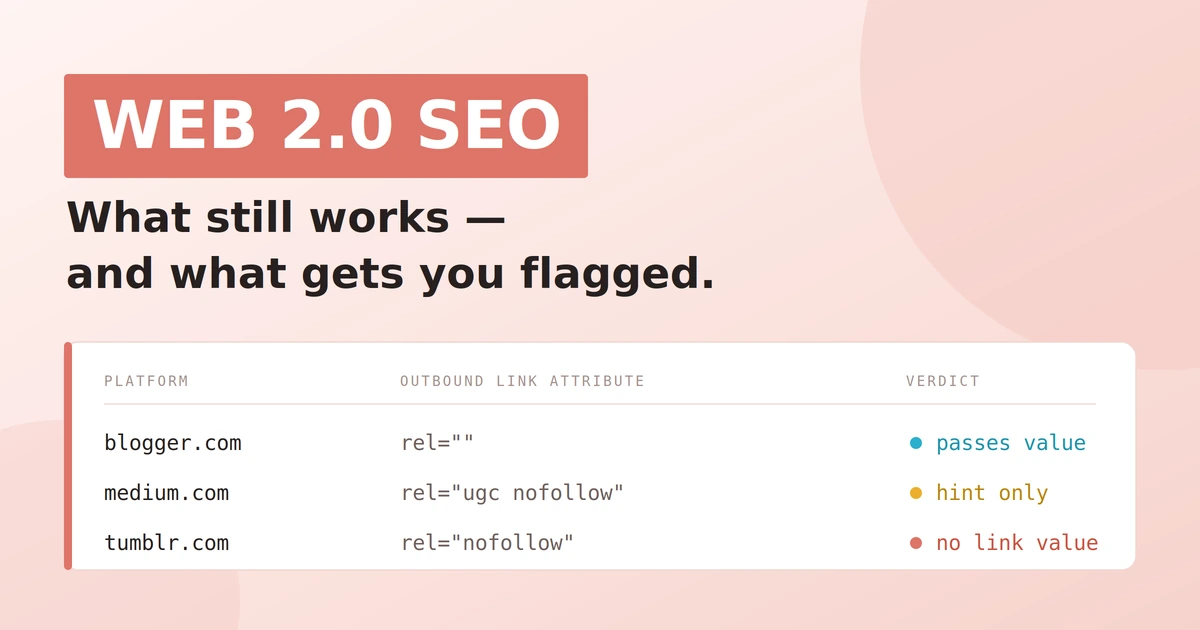
| Platform | Typical outbound link attribute | Realistic 2026 use case |
|---|---|---|
| Blogger / Blogspot | Dofollow in post body | Secondary brand blog. Google-owned; accounts producing thin content are deleted aggressively |
| Medium | rel="noopener ugc nofollow" | Distribution and audience reach. Note: Medium also applies noindex to low-distribution accounts — check your page source |
| WordPress.com (free tier) | Nofollow | Brand presence only; paid plans behave differently |
| Tumblr | Nofollow | Niche audience reach; minimal link value |
| Substack | Generally dofollow | Genuinely useful if you’ll actually maintain a newsletter |
| Weebly / Wix / site builders | Varies by plan | Rarely worth the effort unless it’s a real microsite |
| Quora / Reddit / LinkedIn | Nofollow / UGC | High referral traffic; increasingly cited by AI search systems |
Two things follow from this table:
First, a nofollow link is not a worthless link. Nofollow links from platforms with real traffic drive visitors, generate brand searches, and contribute to the entity associations that both Google and AI systems build around your brand. A balanced backlink profile naturally contains dofollow, nofollow, sponsored, and UGC links — a profile that is 100% dofollow looks manufactured.
Second, stop optimising for the attribute. Pick platforms by audience, not by whether a tool reports “dofollow.”
If you want a vetted starting list, we maintain one separately: Web 2.0 Submission Sites List 2026: Free, High-DA Platforms That Still Work — it’s updated with current attributes and indexation notes.
What people actually search for (our own data)
We pulled 16 months of Google Search Console data for this page (April 2025 – August 2026) to understand what people want when they search Web 2.0 SEO topics. Across 9,200 impressions:
- 13.3% of impressions came from tutorial and how-to queries — web 2.0 seo tutorial, web 2.0 seo techniques, web 2.0 seo example
- 11.3% came from link-building queries — web 2.0 backlinks strategy, web 2.0 link building, what are web 2.0 links
- 6.3% came from purely definitional queries — what is web 2.0 in seo, what is web 2.0 backlinks, what is web 2.0 submission in seo
- 52% of all impressions came from the United States, followed by the UK, Russia, and Brazil
- Notably, people search “web 2.0 seo reddit” and “is web 2.0 still relevant” — searchers are actively looking for a skeptical second opinion, not a sales pitch
That last point shaped this rewrite. If you came here looking for someone to tell you honestly whether this tactic is worth your time, that’s the section above.
Web 2.0 SEO techniques that still work
1. Build fewer properties, maintain them properly
One Blogger blog updated monthly with genuinely useful content will outperform twenty abandoned Weebly pages every time. Pick a maximum of two or three platforms. Give each one a distinct purpose — one for long-form, one for distribution, one for community.
2. Write content that could stand alone
If the post only exists to hold a link, both Google’s classifiers and your readers can tell. Every Web 2.0 post should be something you’d be willing to publish on your own blog. Our content writing services team applies the same editorial standard to off-site properties as on-site ones, for exactly this reason.
3. Vary anchor text heavily
Exact-match anchor concentration is one of the loudest spam signals in a backlink profile. Use brand names, bare URLs, and natural phrases. If more than a small minority of your anchors are commercial keywords, restructure.
4. Link out, not just in
A post that links only to your own site is a transparent link vehicle. Cite sources, link to research, reference other practitioners. This is normal publishing behaviour and it reads as such.
5. Structure the post for extraction
Use proper heading hierarchy, short answer paragraphs, and clear subheadings — the same discipline you’d apply on your own site. We cover the mechanics in our guide to header tags in SEO.
6. Get the property indexed, then verify it stayed indexed
Submit the URL, then check again at 30 and 90 days with a site: search. Unindexed Web 2.0 posts are extremely common and pass nothing. If you’re not checking, you’re not measuring.
7. Treat social platforms as distribution, not link building
Social signals are not a direct Google ranking factor — Google has stated this repeatedly. What social platforms do provide is reach, brand search volume, and referral traffic. Google Search Console now reports on some of this directly; see our breakdown of GSC’s social platform properties.
How to create a Web 2.0 property, step by step
Step 1 — Choose the platform by audience. Where does your target reader already spend time? A B2B SaaS audience is on Substack and LinkedIn. A developer audience is on Hashnode and GitHub. Answer this before you register anything.
Step 2 — Register with brand consistency. Use your brand name in the subdomain, a real logo, a real About page, and a real author bio linking to a real profile. A property with no identity is a property with no trust.
Step 3 — Publish three to five substantial posts before linking anywhere. Establish that the property is a publication, not a link farm.
Step 4 — Introduce contextual links naturally. One or two per post, mid-content, where a reader would actually want to click. Never in the first paragraph, never in the footer, never as a keyword-stuffed sign-off.
Step 5 — Verify indexation. site:yourbrand.blogspot.com at 30 days. If nothing is indexed, the platform has flagged you — diagnose before publishing more.
Step 6 — Keep publishing, or shut it down. An abandoned property decays. If you can’t sustain monthly publishing, don’t start.
Web 2.0 mistakes that get properties deindexed
- Spun or lightly-reworded content. The fastest way to trigger platform-level deletion.
- Identical content across multiple properties. A duplicate footprint across five subdomains is trivially detectable.
- Exact-match anchors on every link. Concentrated commercial anchors are the classic manipulation signal.
- Registering everything in one session from one IP. A creation-date and footprint cluster.
- Buying “web 2.0 backlink packages.” You inherit someone else’s footprint along with the links.
- Zero outbound links to anything but your own site. Statistically abnormal for a real blog.
Where Web 2.0 fits in AI search
This is the part most Web 2.0 guides haven’t caught up with. Google’s AI Mode and AI Overviews, along with ChatGPT and Perplexity, don’t rank pages the way classic SERPs do — they retrieve and synthesise passages, then weight sources by corroboration across the web.
That changes the calculation for Web 2.0 properties in two ways:
It devalues them as link vehicles further. A nofollow link on a thin Tumblr post contributes nothing to how an AI system assesses your brand.
It increases the value of genuine third-party presence. AI systems draw heavily on community platforms — Reddit, Quora, Stack Overflow, Medium — precisely because those platforms contain real practitioner discussion. A well-argued answer from a named expert on one of those platforms does more for your brand’s AI visibility than a hundred subdomain blogs.
If AI search visibility is your goal, Web 2.0 link building is the wrong lever entirely. Start with our complete guide to AI SEO and our explainer on what generative engine optimization (GEO) actually is.
How to measure Web 2.0 SEO properly
Most Web 2.0 campaigns are measured by links built, which measures effort rather than outcome. Track these instead:
| Metric | Where | What good looks like |
|---|---|---|
| Indexed property pages | site: search, monthly | Above 80% of published posts still indexed at 90 days |
| Referral sessions from the property | GA4 → Traffic acquisition | Any measurable, sustained referral traffic |
| Branded search volume | Search Console → Queries | Upward trend in brand-name searches |
| Links to the property itself | Ahrefs / Semrush | The property earning its own links is the strongest signal |
| Assisted conversions | GA4 attribution | The only metric your client actually cares about |
Note what’s missing: Domain Authority of the platform. A DA 95 platform passes nothing through an unindexed nofollow link on a thin post.
Tools worth using
- Google Search Console — indexation status, query data, manual action alerts. Non-negotiable and free.
- Google Analytics 4 — referral traffic and assisted conversions from each property.
- Ahrefs or Semrush — anchor text distribution audit and link discovery. Watch anchor concentration specifically.
- Screaming Frog — crawl your own site to audit link attributes; roughly a tenth of sites carry pointless internal nofollows inherited from old plugins.
- A spreadsheet — property name, creation date, last published date, indexation check date. Unglamorous, and the reason most campaigns fail without it.
Frequently asked questions
What is Web 2.0 in SEO?
Web 2.0 in SEO means using third-party publishing platforms — Blogger, Medium, WordPress.com, Tumblr, Substack — to publish content and link back to your own website. The properties sit on domains you don’t own, which is what distinguishes them from your own blog.
What are Web 2.0 backlinks?
Links to your website from content you published yourself on a third-party platform. They are self-created rather than editorially earned, which is why Google’s systems evaluate them far more sceptically than a link someone gave you unprompted.
Do Web 2.0 backlinks still work in 2026?
Mass-created ones do not — they match documented link spam patterns and are typically discounted before they ever count. A small number of genuinely maintained brand properties still deliver referral traffic, brand signals, and occasional real link value.
Are Web 2.0 links dofollow or nofollow?
It depends entirely on the platform. Blogger and Substack generally pass dofollow links; Medium, Tumblr, WordPress.com’s free tier, Quora and LinkedIn apply nofollow or UGC attributes. Since 2019 Google treats these as hints rather than absolute directives, so nofollow links are not worthless — but you can’t rely on them.
Can Web 2.0 backlinks get my site penalised?
Building a handful of real properties will not. Mass-creating dozens with spun content and exact-match anchors can trigger algorithmic devaluation, and in clear cases a manual action. The more common outcome is simply that the links are ignored and the effort is wasted.
Is Web 2.0 still relevant?
As a link-building tactic, largely no. As a distribution and brand-presence channel, yes — particularly on platforms that AI search systems draw from, like Medium, Substack, Reddit and Quora.
How many Web 2.0 properties should I build?
Two or three that you will genuinely maintain. There is no threshold at which quantity starts to help; past a small number it starts to hurt.
What is Web 2.0 submission in SEO?
The practice of creating an account on a Web 2.0 platform, publishing an article, and including a link to your site. It is the same activity as Web 2.0 link building, described in submission-list terminology. Our Web 2.0 submission sites list covers which platforms are still viable.
Web 2.0 vs guest posting — which is better?
Guest posting on a relevant site with a real editorial standard is stronger, because the link is a third-party endorsement rather than a self-published one. Both fall foul of Google’s policies when done at scale purely for links.
Are paid Web 2.0 backlink services worth it?
Generally no. You inherit the seller’s footprint, you don’t control indexation, and the properties are usually abandoned the moment payment clears. The same budget spent on one piece of genuinely linkable original research will outperform it.
Do Web 2.0 properties help with ChatGPT or Google AI Mode visibility?
Only indirectly, and only the genuine ones. AI systems weight corroborated presence on platforms with real discussion. A thin subdomain blog contributes nothing. See our AI SEO guide for what does.
How long before Web 2.0 SEO shows results?
Referral traffic can appear within weeks if the platform has an existing audience. Any ranking effect, where it exists at all, takes months and is difficult to isolate from other activity — which is itself a reason to prioritise measurable channels first.
The bottom line
Web 2.0 SEO in 2026 is a smaller, more honest tactic than the tutorials suggest. It is not a shortcut to rankings, it never really was, and the version of it that still works looks like publishing rather than link building.
If your foundations aren’t in place, this isn’t where to start. Technical health, on-page structure, and content that genuinely deserves to rank come first — that’s the sequence we work through in our SEO services, and it’s why we wrote about why SEO matters for brand visibility before we wrote about tactics.
Where to go next:
- Web 2.0 Submission Sites List 2026 — vetted platforms with current attributes
- The Complete Guide to AI SEO — ranking in AI Overviews and ChatGPT
- What Is Generative Engine Optimization (GEO)? — the framework behind AI search visibility
- Header Tags SEO — structuring content for both readers and retrieval
- YouTube SEO Guide — video as a second retrieval surface
- Angular SEO Checklist — if your site is JavaScript-heavy
- Local SEO Services — if you’re competing geographically
Have a Web 2.0 campaign you’re unsure about? We audit backlink profiles for anchor concentration and footprint risk as part of our SEO services. Get in touch.

Amir Siddiqui is a Digital Marketing Expert and SEO Specialist with over 8 years of experience helping businesses grow through data-driven digital marketing strategies. As the Founder of Web Marlins Pvt. Ltd., his core expertise lies in Search Engine Optimization (SEO), including Technical SEO, Local SEO, AI SEO, and content strategy. He has helped businesses across India, the USA, and the UAE improve search rankings, increase organic traffic, and generate high-quality leads through sustainable, results-focused SEO solutions.