
Updated: July 28, 2026
Generative Engine Optimization (GEO) is the process of optimizing your website and content so that AI-powered search engines and generative AI assistants like ChatGPT, Google AI Overviews, Gemini, Claude, and Perplexity can understand, trust, and reference your content in their responses.
What Is Generative Engine Optimization (GEO)?
Search is changing faster than it has in the past decade. Instead of clicking through ten blue links on a search engine results page (SERP), users are increasingly turning to AI-powered search experiences that generate complete answers in seconds.
Whether someone asks ChatGPT for the best SEO strategy, uses Google’s AI Overviews to compare products, or searches on Perplexity for in-depth research, the way information is discovered is evolving. Traditional rankings still matter, but they are no longer the only path to visibility.
This shift has given rise to Generative Engine Optimization (GEO)—a modern approach to content optimization designed for AI-driven search experiences.
Generative Engine Optimization is the practice of creating, structuring, and optimizing content so that generative AI systems can accurately understand, trust, and reference it when generating responses to user queries.
Unlike traditional SEO, which focuses on improving rankings in search engine results pages, GEO emphasizes becoming a trusted source for AI-generated answers.
For businesses, publishers, and marketers, this means success is no longer measured solely by ranking on page one of Google. It also depends on whether AI assistants recognize your content as authoritative enough to include in their responses.
As AI continues to reshape online search, GEO is becoming an essential component of any future-ready digital marketing strategy.
Understanding Generative Engine Optimization
To understand GEO, it’s helpful to first understand how modern AI search differs from traditional search.
Traditional search engines retrieve documents based on hundreds of ranking signals, including authority backlinks, keywords, page experience, and authority. Users are then presented with a list of webpages and choose which result to visit.
Generative AI works differently.
Instead of simply displaying links, AI systems analyze information from multiple trusted sources, synthesize that information, and generate a direct answer. The response often combines insights from several websites rather than relying on a single page.
Because of this, content must be optimized not only to rank well but also to be easily interpreted, verified, and summarized by AI models.
That is exactly what GEO aims to accomplish.
A strong GEO strategy helps AI systems understand:
- What your content is about
- Why it is trustworthy
- Which questions it answers
- How it relates to other authoritative topics
- Whether it deserves to be cited or referenced
Think of traditional SEO as helping search engines find your website, while Generative Engine Optimization helps AI systems understand and confidently explain your content.
Why Generative Engine Optimization Matters
The rapid adoption of AI search is transforming how people access information online.
Millions of users now rely on AI assistants for:
- Product recommendations
- Technical tutorials
- Business research
- Educational content
- Travel planning
- Health information
- Software comparisons
- Marketing advice
Instead of browsing multiple websites, users increasingly expect a single, comprehensive answer.
For businesses, this creates both opportunities and challenges.
If your website becomes one of the trusted sources AI models reference, your brand gains visibility even when users never perform a traditional Google search.
On the other hand, websites that rely only on conventional SEO techniques may lose visibility as AI-generated answers become more common.
Generative Engine Optimization helps bridge this gap by ensuring your content remains discoverable in both traditional search engines and AI-powered search experiences.
The Rise of AI Search
Search has gone through several major phases over the past three decades.
Phase 1: Keyword-Based Search
Early search engines relied heavily on exact keyword matching. Websites that repeated keywords frequently often ranked well, regardless of content quality.
Phase 2: Authority-Based Search
As search engines became more sophisticated, ranking algorithms began evaluating backlinks, website authority, and user experience alongside keywords.
This era introduced concepts such as:
- Domain authority
- Page authority
- Technical SEO
- Mobile optimization
- Core Web Vitals
Phase 3: Semantic Search
Google’s improvements in natural language processing enabled search engines to better understand context rather than relying solely on exact keywords.
Search intent became more important than keyword density.
Phase 4: AI-Powered Search
Today’s search landscape is powered by large language models (LLMs) capable of understanding complex questions and generating conversational responses.
Examples include:
- Google AI Overviews
- ChatGPT Search
- Perplexity AI
- Microsoft Copilot
- Claude
- Gemini
Rather than presenting ten links, these platforms attempt to answer the user’s question immediately.
This evolution has made AI search optimization an increasingly important discipline.
How AI Search Engines Work
One of the biggest misconceptions about AI search is that it simply copies information from websites.
In reality, modern AI systems follow a much more sophisticated process.
Step 1: Understand the User’s Intent
Instead of focusing only on keywords, AI models interpret what the user actually wants.
For example:
Search Query
“What’s the best SEO strategy for AI search?”
The AI understands that the user is seeking actionable advice rather than a dictionary definition.
Step 2: Retrieve Relevant Information
Depending on the platform, the AI may retrieve relevant information from:
- Trusted websites
- Search indexes
- Knowledge graphs
- Structured databases
- Previously indexed content
- Real-time web search (where supported)
The quality of these sources plays a major role in the generated response.
Step 3: Evaluate Content Quality
Before using information, AI systems assess signals such as:
- Expertise
- Accuracy
- Context
- Completeness
- Freshness
- Consistency
- Authority
Content that demonstrates genuine expertise and provides comprehensive answers is more likely to influence AI-generated responses.
Step 4: Generate the Response
Finally, the AI synthesizes information into a natural, conversational answer tailored to the user’s question.
Instead of quoting a single webpage, it combines knowledge from multiple trusted sources while maintaining coherence and relevance.
This is why publishing comprehensive, accurate, and well-structured content is one of the foundations of effective Generative Engine Optimization.
Why GEO Is Different From Traditional SEO
Although GEO builds upon many established SEO principles, its primary objective is different.
Traditional SEO is designed to improve visibility in search engine results pages.
GEO is designed to increase the likelihood that AI systems will understand, trust, and reference your content when generating answers.
The most successful digital marketing strategies today combine both approaches rather than treating them as competing disciplines.
In the next section, we’ll compare GEO with traditional SEO, Answer Engine Optimization (AEO), and Large Language Model Optimization (LLMO), and explore the practical strategies you can implement to improve your visibility in AI search.
GEO vs SEO vs AEO vs LLMO
As AI-powered search evolves, several new optimization terms have emerged. While they are closely related, each has a distinct purpose.
Understanding these differences helps businesses develop a comprehensive search strategy rather than focusing on a single optimization method.
| Factor | SEO | GEO | AEO | LLMO |
|---|---|---|---|---|
| Primary Goal | Rank higher in search engines | Get referenced in AI-generated responses | Answer voice and direct-answer queries | Improve visibility in Large Language Models |
| Target Platforms | Google, Bing | ChatGPT, Gemini, Claude, Perplexity, AI Overviews | Voice Assistants, Featured Snippets | LLM-based applications |
| Focus | Rankings and traffic | AI citations and visibility | Direct answers | AI model comprehension |
| Content Style | Keyword-focused | Context-rich and comprehensive | Concise question-answer format | Structured, factual, entity-based |
| Success Metric | Organic traffic | AI mentions and citations | Featured snippets | AI visibility |
Although these strategies differ, they complement one another rather than compete.
For example:
- Strong SEO helps your content get discovered and indexed.
- AEO improves your chances of appearing in featured snippets and voice search.
- GEO increases the likelihood that AI assistants will reference your content.
- LLMO focuses on making content easier for large language models to interpret and trust.
The future belongs to businesses that integrate all four into a unified search strategy.
Why Traditional SEO Alone Is No Longer Enough
For years, ranking on the first page of Google was the ultimate goal of digital marketing.
Today, user behavior has changed.
Instead of searching:
“Best CRM software”
Many users now ask:
“Which CRM is best for a small business with fewer than 20 employees?”
AI assistants generate a personalized answer instead of displaying only search results.
This changes how websites earn visibility.
Traditional SEO focuses on attracting clicks.
Generative Engine Optimization focuses on becoming part of the answer itself.
Even if users never visit your website directly, appearing in AI-generated responses builds:
- Brand awareness
- Authority
- Trust
- Future search demand
Businesses that ignore GEO risk becoming less visible as AI-generated search experiences continue to expand.
How ChatGPT, Gemini, Claude and Perplexity Choose Sources
One of the most common misconceptions about AI search is that it simply copies content from websites.
Modern AI systems don’t work that way.
Instead, they evaluate content using multiple quality signals before incorporating information into their responses.
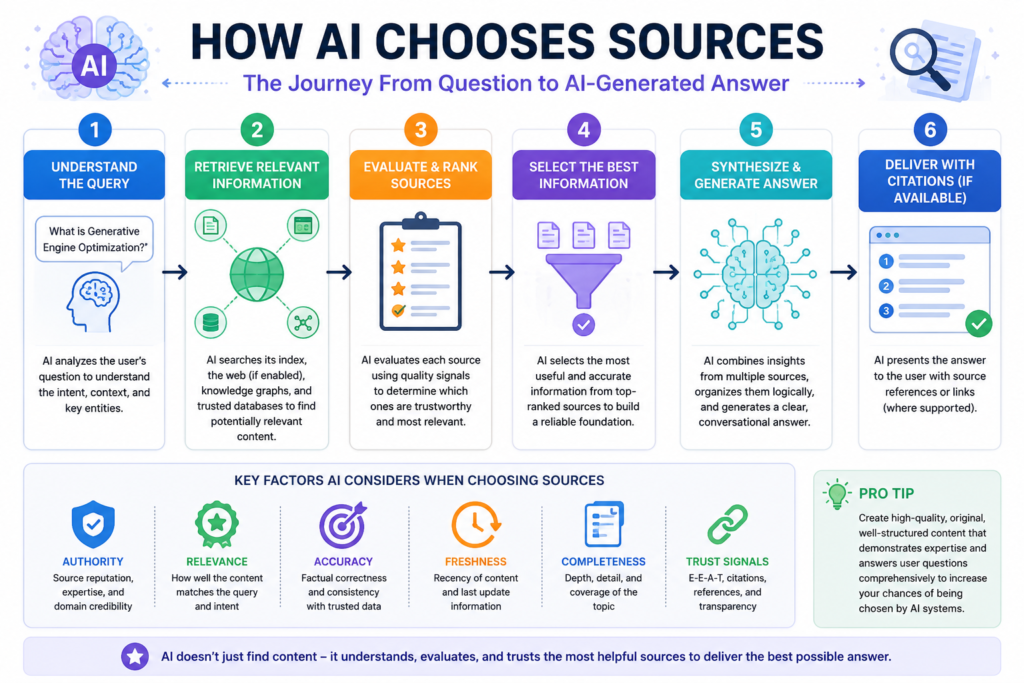
Although every AI platform has its own architecture, most follow similar evaluation principles.
1. Content Quality
AI prefers content that thoroughly explains a topic rather than providing superficial information.
A 3,000-word comprehensive guide often has a greater chance of influencing AI responses than a 500-word article that barely scratches the surface.
Quality indicators include:
- Original insights
- Practical examples
- Step-by-step explanations
- Updated information
- Supporting evidence
2. Expertise
AI systems increasingly prioritize content written by people or organizations with demonstrated expertise.
For example, a cybersecurity company writing about network security is generally a stronger source than a generic lifestyle blog discussing the same topic.
Ways to demonstrate expertise include:
- Detailed author profiles
- Professional credentials
- Industry experience
- Original research
- Case studies
- Real-world examples
3. Topical Authority
Publishing one excellent article is rarely enough.
AI systems evaluate whether your website consistently covers a subject in depth.
Imagine two websites.
Website A
Publishes one article about SEO.
Website B
Publishes:
- Technical SEO
- Local SEO
- Entity SEO
- GEO
- AI Search
- Schema
- Core Web Vitals
- Internal Linking
- Crawl Budget
- E-E-A-T
Which website appears more authoritative?
Almost always, Website B.
This is why topical authority is becoming one of the strongest ranking and citation signals.
4. Content Freshness
AI-powered search increasingly favors current information.
For example, an article titled:
“Google AI Overview Ranking Factors (Updated 2026)”
is generally more valuable than:
“AI Search Guide 2023.”
Regular updates signal that your content remains relevant.
Consider refreshing:
- Statistics
- Screenshots
- Examples
- Internal links
- Product information
- Industry developments
5. Entity Relationships
Traditional SEO focused heavily on keywords.
Modern AI understands relationships between concepts.
For example, in an article about Generative Engine Optimization, AI expects related entities such as:
- Artificial Intelligence
- Large Language Models
- ChatGPT
- Google AI Overviews
- Semantic Search
- Structured Data
- E-E-A-T
- Natural Language Processing (NLP)
- Schema Markup
- Knowledge Graph
Including these naturally helps AI better understand your content.
6. Structured Content
AI prefers content that is easy to interpret.
Instead of writing large blocks of text, organize information using:
- Clear headings
- Lists
- Tables
- FAQs
- Comparison charts
- Numbered steps
- Summary boxes
A well-structured article benefits both readers and AI systems.
Read Also: ChatGPT Search Optimization Guide
The 10 Core Principles of Generative Engine Optimization
A successful GEO strategy is built on several foundational principles.
Let’s examine each one.
1. Write for Humans First
One of the biggest mistakes in AI SEO is trying to “write for AI.”
AI models are trained to identify content that genuinely helps users.
Instead of asking:
“How can I rank?”
Ask:
“How can I solve this problem better than anyone else?”
Helpful content naturally performs better in both traditional and AI search.
2. Cover Topics Comprehensively
AI prefers complete resources.
For example, an article titled:
“What Is Generative Engine Optimization?”
should answer questions such as:
- What is GEO?
- Why does it matter?
- How does it work?
- Benefits
- Best practices
- Tools
- Common mistakes
- Future trends
- FAQs
The more relevant questions you answer, the more valuable your content becomes.
3. Build Topic Clusters
Rather than publishing isolated articles, create interconnected content.
Example:
Pillar Page
Supporting Articles
- What Is GEO?
- What Is LLMO?
- Entity SEO Explained
- AI Search Optimization Checklist
- Google AI Overviews Guide
- Schema for AI Search
- How ChatGPT Chooses Sources
- AI SEO Tools
- GEO Case Studies
Internal links between these pages strengthen topical authority and help AI understand the relationships between concepts.
4. Demonstrate Real Experience
Experience is becoming increasingly valuable.
Instead of saying:
“Schema improves SEO.”
Explain:
“After implementing Article, FAQ, and Organization schema on a client website, we observed improved indexing and more frequent visibility in AI-generated search summaries over the following months.”
Original experience is difficult to replicate and adds credibility.
5. Use Clear, Direct Answers
AI systems often extract concise explanations.
For example:
What is GEO?
Good Answer
Generative Engine Optimization (GEO) is the process of optimizing content so AI-powered search engines can understand, trust, and reference it in generated responses.
Notice how the definition is direct, complete, and easy to quote.
6. Strengthen Internal Linking
Internal links help AI understand your website’s structure.
For example:
A GEO article should naturally link to:
- AI SEO Guide
- Entity SEO
- Schema Markup
- Technical SEO
- E-E-A-T
- Content Marketing
Strong internal linking improves topical relationships.
7. Maintain Information Accuracy
AI systems evaluate consistency across multiple trusted sources.
Avoid:
- Outdated statistics
- Unsupported claims
- Incorrect definitions
- Broken links
Accurate information builds trust with both users and AI systems.
8. Improve Readability
Content should be easy to scan.
Best practices include:
- Short paragraphs
- Bullet lists
- Tables
- Visual elements
- Logical headings
- Clear formatting
Better readability improves engagement and helps AI identify key information.
9. Optimize for Entities Instead of Just Keywords
Instead of repeating:
“Generative Engine Optimization”
twenty times, discuss related concepts naturally.
Examples include:
- AI Search
- NLP
- Search Intent
- Knowledge Graph
- Machine Learning
- Semantic Search
- Large Language Models
- Content Authority
This creates richer semantic context.
10. Build Trust
Trust remains one of the strongest signals for both search engines and AI.
Ways to build trust include:
- Publishing accurate information
- Updating content regularly
- Displaying author credentials
- Providing citations where appropriate
- Sharing original research
- Maintaining transparent editorial standards
Trust is not built overnight—it is earned through consistent quality.
Benefits of Generative Engine Optimization
Businesses that invest in GEO today position themselves for the future of search.
Here are some of the most significant advantages.
Increased AI Visibility
As AI-generated answers become more common, optimized content has a greater chance of being referenced, increasing brand exposure beyond traditional search results.
Stronger Brand Authority
When AI platforms consistently rely on your content, users begin to associate your brand with expertise in your industry.
Improved Organic Performance
Many GEO best practices—such as creating comprehensive, well-structured content and building topical authority—also support traditional SEO, often leading to better organic rankings.
Higher Content Longevity
Evergreen, high-quality content optimized for AI tends to remain valuable for longer, especially when it is updated regularly with fresh information and examples.
Better User Experience
GEO encourages content that is clear, useful, and easy to navigate. This benefits readers through improved readability and helps AI systems interpret your pages more effectively.
Competitive Advantage
Many businesses are still focused solely on traditional SEO. Adopting GEO now allows you to establish authority before AI search optimization becomes standard practice across your industry.
More Qualified Traffic
Users who discover your brand through AI-generated answers are often seeking specific solutions. This can result in visitors who are more informed and more likely to engage with your products or services.
Future-Proof Search Strategy
Search technology will continue to evolve, but the core principles behind GEO—helpful content, expertise, trust, and semantic clarity—are likely to remain valuable regardless of the platform.
Expert Tip
Think beyond rankings.
The goal of Generative Engine Optimization isn’t just to appear on page one—it’s to become one of the trusted sources that AI systems rely on when answering users’ questions. Brands that consistently publish original, authoritative, and well-structured content will be better positioned as AI-powered search continues to grow.
15 Best Practices for Generative Engine Optimization (GEO)
Understanding GEO is only the first step. The real value comes from implementing strategies that help AI-powered search engines understand, trust, and reference your content.
The following best practices are designed to improve your visibility across AI search platforms while strengthening your traditional SEO efforts.
1. Create People-First Content
Google and AI search platforms increasingly reward content written for people rather than algorithms.
Before publishing any article, ask yourself:
- Does this solve a real problem?
- Would someone bookmark or share this?
- Does it answer follow-up questions?
- Is it better than competing articles?
If the answer is yes, you’re moving in the right direction.
Pro Tip: Don’t write for ChatGPT. Write for your audience. AI systems are trained to recognize genuinely helpful content.
2. Cover the Topic Completely
Thin content rarely becomes a trusted AI source.
Instead of writing a 700-word article, create comprehensive resources that answer every important question.
For example, an article on Generative Engine Optimization should include:
- Definition
- Importance
- History
- AI search evolution
- GEO vs SEO
- Best practices
- Tools
- Checklist
- FAQs
- Future trends
The more complete your coverage, the more useful your content becomes.
3. Focus on Search Intent
Every search query has an underlying intent.
Common search intents include:
| Search Intent | Example |
|---|---|
| Informational | What is GEO? |
| Commercial | Best AI SEO tools |
| Transactional | Hire GEO agency |
| Navigational | OpenAI documentation |
Match your content to the user’s intent rather than forcing keywords into unrelated pages.
4. Use Semantic Keywords Naturally
Instead of repeating Generative Engine Optimization dozens of times, include semantically related terms such as:
- AI Search
- AI Search Optimization
- LLM
- Natural Language Processing
- Knowledge Graph
- Search Intent
- Entity SEO
- Schema Markup
- Content Authority
- AI Crawlers
This creates richer context for AI systems.
5. Build Strong Topic Clusters
Publishing isolated articles limits your authority.
Instead, organize content into topic clusters.
Example:
Pillar Page
Supporting Articles:
- What Is GEO?
- Entity SEO Explained
- AI Search Optimization Checklist
- How ChatGPT Chooses Sources
- Google AI Overviews Guide
- LLMO vs GEO
- AI SEO Ranking Factors
- Schema Markup for AI Search
- AI Content Optimization
This structure strengthens topical authority and improves internal linking.
6. Add Original Insights
AI platforms value unique information.
Don’t simply summarize existing articles.
Include:
- Industry observations
- Practical recommendations
- Client experiences (where appropriate)
- Original frameworks
- Custom graphics
- Proprietary checklists
- First-hand analysis
Original insights make your content more distinctive and credible.
7. Keep Content Fresh
AI search platforms favor current information.
Regularly update:
- Statistics
- Examples
- Screenshots
- Product features
- Industry developments
- Internal links
A review every three to six months helps maintain relevance.
8. Use Question-Based Headings
Many AI-generated responses are built around user questions.
Examples:
- What Is GEO?
- How Does GEO Work?
- Why Is GEO Important?
- How Can Businesses Optimize for AI Search?
Question-based headings align well with conversational search behavior.
9. Improve Readability
Complex formatting discourages readers and makes content harder to process.
Follow these guidelines:
- Keep paragraphs short.
- Use descriptive headings.
- Break up long sections with bullet lists.
- Include comparison tables.
- Add visuals where appropriate.
Readable content benefits both users and AI.
10. Demonstrate Experience
Experience is a critical component of Google’s E-E-A-T framework.
Where relevant, include:
- Real-world examples
- Personal observations
- Case studies
- Lessons learned
- Before-and-after comparisons
Authentic experience adds credibility that generic AI-generated content often lacks.
11. Strengthen Internal Linking
Every supporting article should connect naturally to related resources.
For example, this article should link to:
- AI SEO Guide
- Entity SEO
- Schema Markup
- Technical SEO
- Content Marketing
- Google AI Overviews
- LLMO Guide
Internal links help both users and AI understand your site’s structure.
12. Optimize Images
Images contribute to user engagement and semantic understanding.
For each image:
- Use descriptive filenames.
- Add meaningful alt text.
- Compress file sizes.
- Place images near relevant content.
Example:
Filename
generative-engine-optimization-process.png
Alt Text
“Illustration showing the Generative Engine Optimization workflow from content creation to AI-generated search results.”
13. Publish Under Recognizable Authors
Author pages build trust.
Include:
- Professional biography
- Relevant experience
- Social profiles
- Company role
- Published articles
Clear authorship supports credibility and transparency.
14. Improve Technical Performance
AI systems still rely on strong technical foundations.
Optimize:
- Page speed
- Mobile responsiveness
- Crawlability
- HTTPS security
- Clean URL structure
- XML sitemap
- Robots.txt configuration
Technical SEO remains essential to GEO success.
15. Measure and Improve
GEO is an ongoing process.
Track:
- Organic traffic
- AI referral traffic (where measurable)
- Brand mentions
- Click-through rates
- Time on page
- Internal link performance
- Content updates
Continuous improvement leads to better long-term visibility.
Technical GEO Optimization Checklist
Technical optimization supports both search engines and AI systems by making your content easier to discover, interpret, and trust.
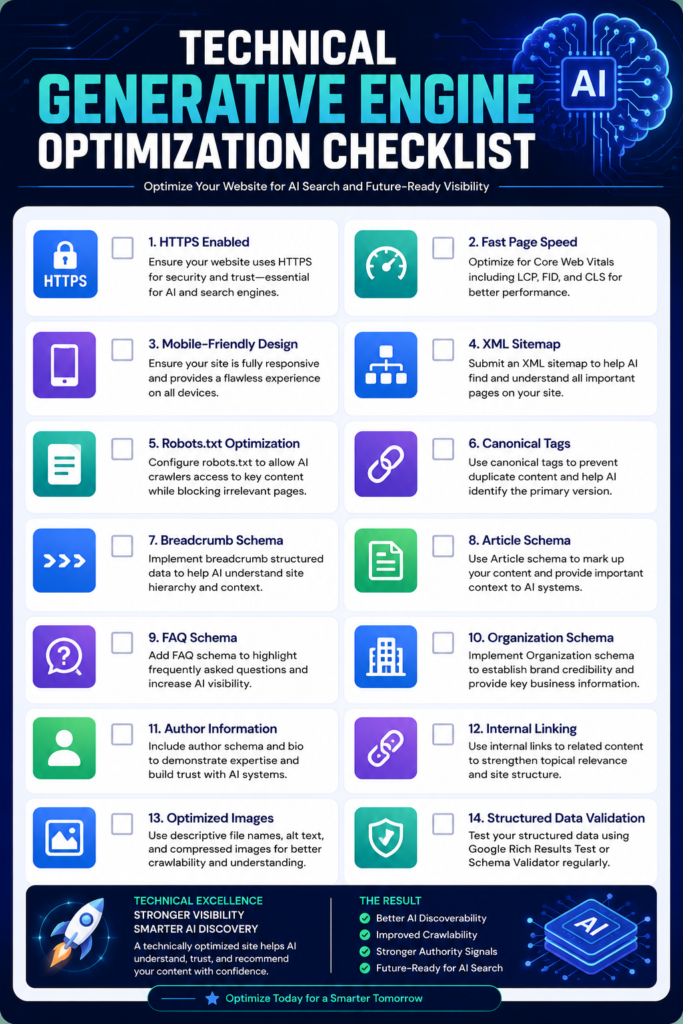
| Task | Status |
|---|---|
| HTTPS enabled | ✅ |
| Fast page speed | ✅ |
| Mobile-friendly design | ✅ |
| XML Sitemap | ✅ |
| Robots.txt configured | ✅ |
| Canonical tags | ✅ |
| Breadcrumb schema | ✅ |
| Article schema | ✅ |
| FAQ schema | ✅ |
| Organization schema | ✅ |
| Author information | ✅ |
| Internal links | ✅ |
| Optimized images | ✅ |
Recommended Schema Markup for GEO
Structured data provides additional context to search engines and AI systems.
For informational articles like this one, consider implementing:
- Article Schema – Identifies the page as a published article.
- FAQ Schema – Highlights question-and-answer sections.
- Organization Schema – Describes your business.
- Breadcrumb Schema – Clarifies page hierarchy.
- Person Schema – Associates the content with its author.
- WebPage Schema – Adds page-level metadata.
While schema alone doesn’t guarantee AI citations, it improves machine readability.
Common GEO Mistakes to Avoid
Many websites fail to benefit from GEO because they focus on outdated SEO practices or overlook what AI systems value most.
Avoid these common mistakes:
Publishing Thin Content
Short articles that only define a topic without offering depth rarely become authoritative references.
Overusing Keywords
Keyword stuffing reduces readability and can weaken trust. Use natural language and semantic variations instead.
Ignoring Internal Linking
Disconnected articles make it harder for search engines and AI to understand topical relationships.
Not Updating Content
Outdated information can reduce credibility. Refresh your content regularly with current examples and insights.
Missing Structured Data
Without schema markup, AI systems may have less context about your content.
Lacking Original Value
If your article simply repeats what every other website says, it is less likely to stand out.
Mini Case Study: Building an AI SEO Content Cluster
Imagine a digital marketing agency launching a new resource hub on AI SEO.
Instead of publishing a single article titled “What Is AI SEO?“, the agency develops a comprehensive content cluster that includes:
- What Is Generative Engine Optimization?
- Entity SEO Explained
- AI Search Optimization Checklist
- Google AI Overviews Guide
- LLMO vs GEO vs AEO
- How ChatGPT Chooses Sources
- Best Schema Markup for AI Search
- AI SEO Ranking Factors
Each article links back to the main AI SEO guide and to related supporting resources.
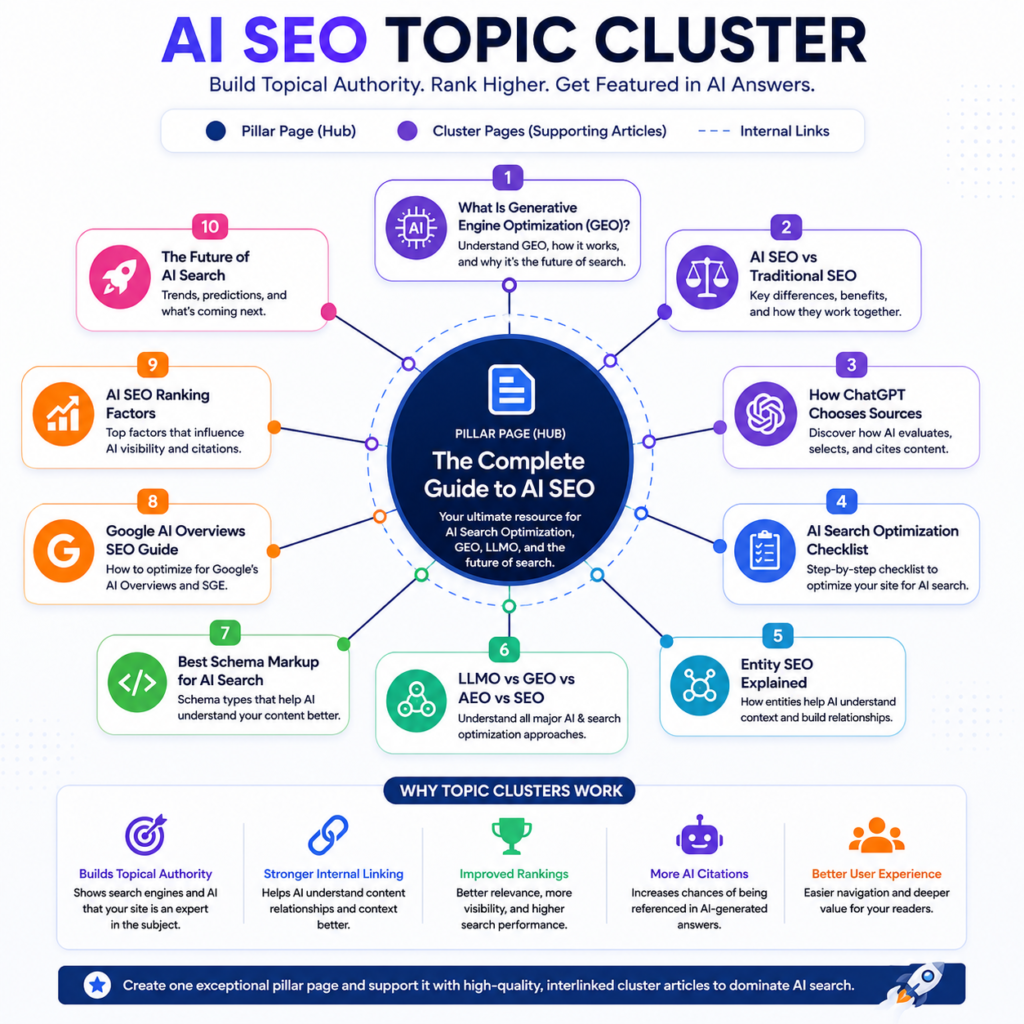
This structure helps search engines and AI systems recognize the site’s depth of expertise, strengthening topical authority over time.
Generative Engine Optimization Checklist
Before publishing a page, review this checklist:
- Define a clear search intent.
- Cover the topic comprehensively.
- Use descriptive headings.
- Include semantic keywords.
- Add internal links to related articles.
- Optimize images and alt text.
- Implement appropriate schema markup.
- Provide clear author information.
- Review content for accuracy.
- Update statistics and examples.
- Test mobile usability.
- Improve page speed.
- Proofread for readability.
Read Also: Why Web Marlins is the Best Generative Engine Optimization Company For AI Visibility
Frequently Asked Questions
What is Generative Engine Optimization (GEO)?
Generative Engine Optimization is the practice of optimizing content so AI-powered search engines and assistants can understand, trust, and reference it in generated responses.
Is GEO replacing traditional SEO?
No. GEO complements traditional SEO. Ranking in search engines remains important, while GEO helps improve visibility in AI-generated answers.
Which AI platforms benefit from GEO?
GEO principles are relevant for AI-powered experiences such as ChatGPT, Google AI Overviews, Gemini, Claude, Perplexity, and similar systems that generate or summarize answers.
What is the difference between GEO and AEO?
GEO focuses on improving visibility in AI-generated responses, while Answer Engine Optimization (AEO) is primarily concerned with providing direct answers for voice search and featured snippets.
Does schema markup help GEO?
Schema markup improves machine readability and provides additional context, making it easier for search engines and AI systems to interpret your content.
Is long-form content better for GEO?
Length alone isn’t the goal. Comprehensive, accurate, and well-structured content that satisfies user intent tends to perform better than thin or incomplete pages.
How often should I update GEO content?
Review important articles every three to six months, or sooner if there are significant changes in AI search features or industry developments.
What role does E-E-A-T play in GEO?
Experience, Expertise, Authoritativeness, and Trustworthiness remain important quality signals that support both traditional SEO and AI search visibility.
Can small businesses benefit from GEO?
Yes. By publishing helpful, niche-specific content and demonstrating expertise, businesses of all sizes can improve their visibility in AI-driven search experiences.
What is the future of Generative Engine Optimization?
As AI continues to influence how users discover information, GEO is likely to become an increasingly important part of digital marketing strategies alongside traditional SEO.
Conclusion
Generative Engine Optimization represents the next stage in the evolution of search. While traditional SEO remains essential for earning visibility in search engine results, AI-powered search platforms are changing how users access information and how content is discovered.
Success in this new landscape requires more than keyword optimization. Businesses need to create accurate, comprehensive, and well-structured content that demonstrates expertise, addresses user intent, and provides genuine value. By combining strong technical SEO, topical authority, semantic optimization, structured data, and people-first content, you increase the likelihood that AI systems will recognize your website as a trustworthy source.
Rather than viewing GEO as a replacement for SEO, treat it as an extension of a modern search strategy. Organizations that invest in high-quality content today will be better positioned to earn visibility across both traditional search engines and AI-powered experiences in the years ahead.

Amir Siddiqui is a Digital Marketing Expert and SEO Specialist with over 8 years of experience helping businesses grow through data-driven digital marketing strategies. As the Founder of Web Marlins Pvt. Ltd., his core expertise lies in Search Engine Optimization (SEO), including Technical SEO, Local SEO, AI SEO, and content strategy. He has helped businesses across India, the USA, and the UAE improve search rankings, increase organic traffic, and generate high-quality leads through sustainable, results-focused SEO solutions.