
Updated: July 24, 2026
Artificial Intelligence has fundamentally changed how people search for information online. Instead of scrolling through ten blue links on a search engine results page (SERP), users now ask conversational questions to AI-powered platforms like ChatGPT, Google AI Overviews, Gemini, Claude, Microsoft Copilot, and Perplexity AI. These platforms generate direct answers by combining information from trusted sources rather than simply listing websites.
For businesses, marketers, and SEO professionals, this shift represents both a challenge and an opportunity. Traditional SEO techniques remain important, but they are no longer enough on their own. To remain visible in this new search environment, websites must also optimize for AI-powered search experiences.
This is where AI SEO comes in.
AI SEO is the practice of optimizing your website and content so that artificial intelligence search systems can understand, trust, cite, and recommend your information in generated responses. Instead of focusing solely on rankings, AI SEO emphasizes authority, expertise, structured information, topical depth, and user intent.
Whether you run an eCommerce store, SaaS business, local service company, or enterprise website, learning AI SEO today can help you gain visibility where millions of users are increasingly searching.
In this comprehensive guide, you’ll learn how AI search works, what ranking signals matter, and the strategies you need to appear in ChatGPT, Google AI Overviews, Perplexity AI, Gemini, Claude, and future AI search engines.
What Is AI SEO?
AI SEO (Artificial Intelligence Search Engine Optimization) is the process of optimizing websites and digital content to improve visibility in AI-powered search engines and generative answer systems.
Unlike traditional SEO, which focuses on ranking webpages in search engine results, AI SEO aims to make your content understandable, trustworthy, and easily reusable by large language models (LLMs) and AI search platforms.
The goal is not only to rank on Google but also to become a trusted source that AI assistants reference when generating answers.
AI SEO combines traditional SEO best practices with newer optimization techniques such as:
- Building topical authority
- Demonstrating Experience, Expertise, Authoritativeness, and Trustworthiness (E-E-A-T)
- Using structured data and schema markup
- Creating comprehensive content clusters
- Optimizing for conversational queries
- Publishing original research and expert insights
- Strengthening brand authority across the web
In simple terms, AI SEO ensures your content is optimized for both humans and intelligent machines.
Why AI SEO Matters in 2026
Search behavior has evolved dramatically over the last few years.
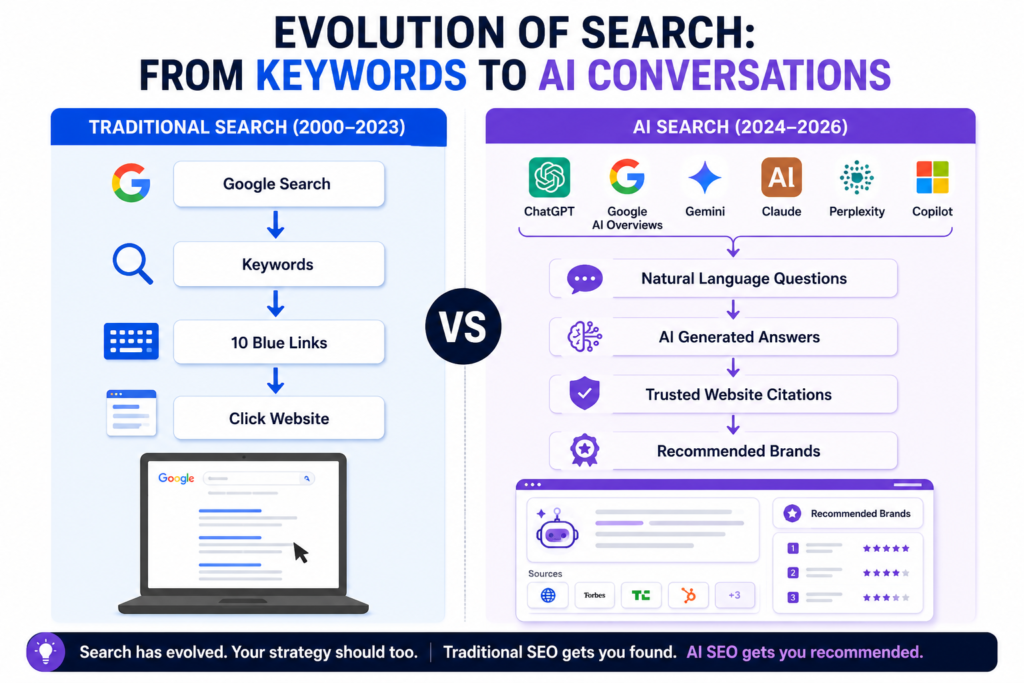
Instead of typing short keyword-based searches like:
“best SEO agency”
Users now ask:
- Which SEO agency is best for SaaS startups?
- How do I rank my website in ChatGPT?
- What are the best AI SEO strategies for 2026?
- Can AI replace traditional SEO?
These conversational questions require AI systems to analyze multiple trusted sources before generating a response.
If your website consistently demonstrates expertise, provides accurate information, and covers topics comprehensively, it becomes more likely to be referenced by these systems.
Businesses that ignore AI SEO risk losing visibility even if they continue ranking well in traditional organic search.
Traditional SEO vs AI SEO
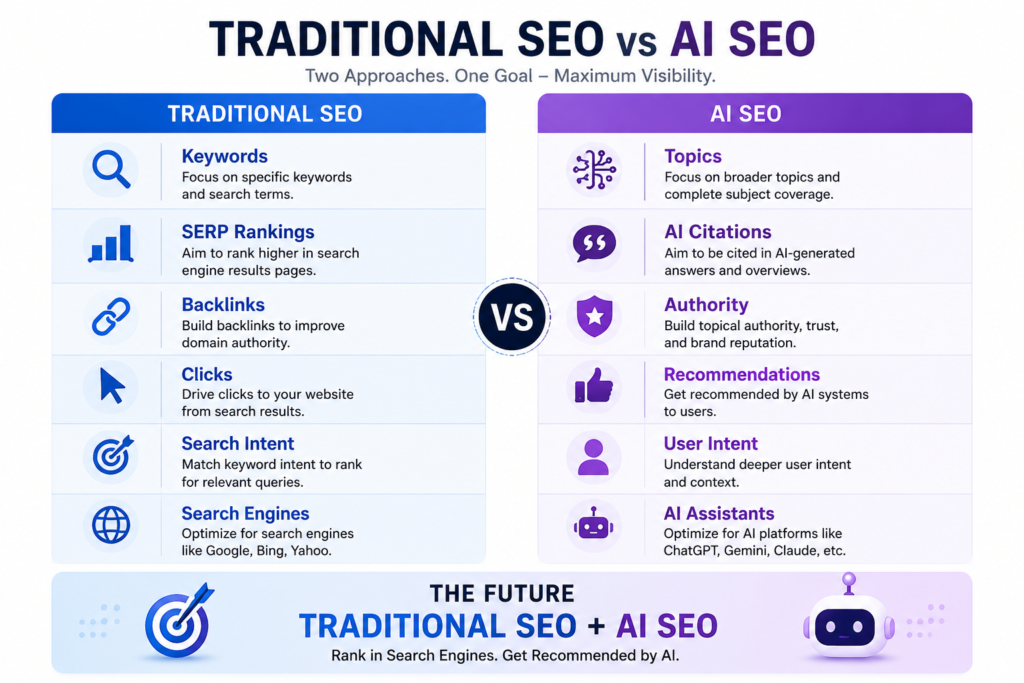
Although AI SEO builds on traditional SEO principles, the two approaches differ in several important ways.
| Traditional SEO | AI SEO |
|---|---|
| Optimizes for Google rankings | Optimizes for AI-generated answers |
| Focuses on keywords | Focuses on topics and user intent |
| Targets search result clicks | Targets AI citations and recommendations |
| Measures rankings and traffic | Measures mentions, citations, and visibility |
| Emphasizes backlinks | Emphasizes authority, trust, and content quality |
| Competes for positions | Competes to become a trusted source |
Traditional SEO remains essential, but AI SEO expands your optimization strategy to include the rapidly growing ecosystem of AI-powered search experiences.
The Rise of AI Search
Artificial intelligence is reshaping how search engines retrieve and present information.
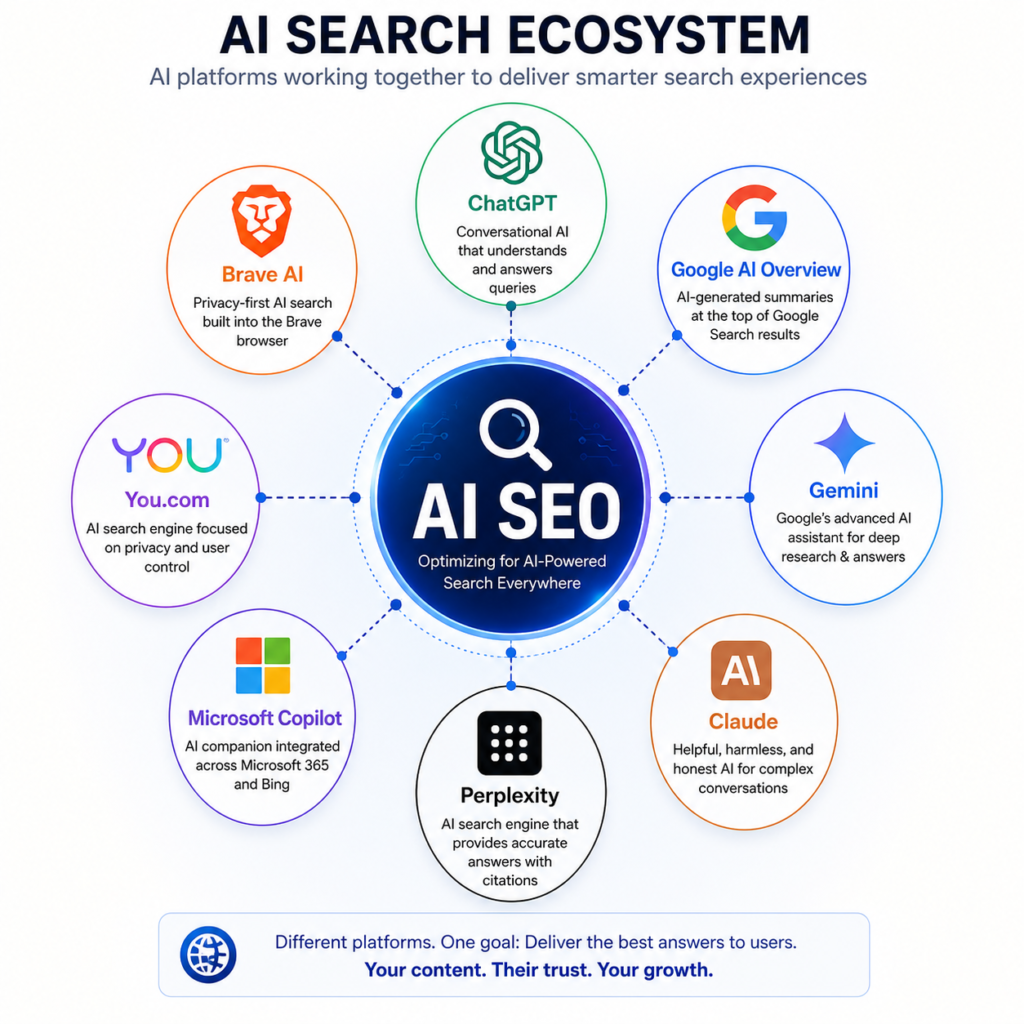
Today, users interact with AI through platforms such as:
- ChatGPT Search
- Google AI Overviews
- Google Gemini
- Microsoft Copilot
- Claude AI
- Perplexity AI
- You.com
- Brave AI Search
Rather than returning a list of webpages, these platforms synthesize information from multiple trusted sources into a single response.
For website owners, this means visibility is increasingly determined by whether AI systems consider your content reliable enough to cite.
How AI Search Works
Although every AI platform uses its own technology, most follow a similar process.
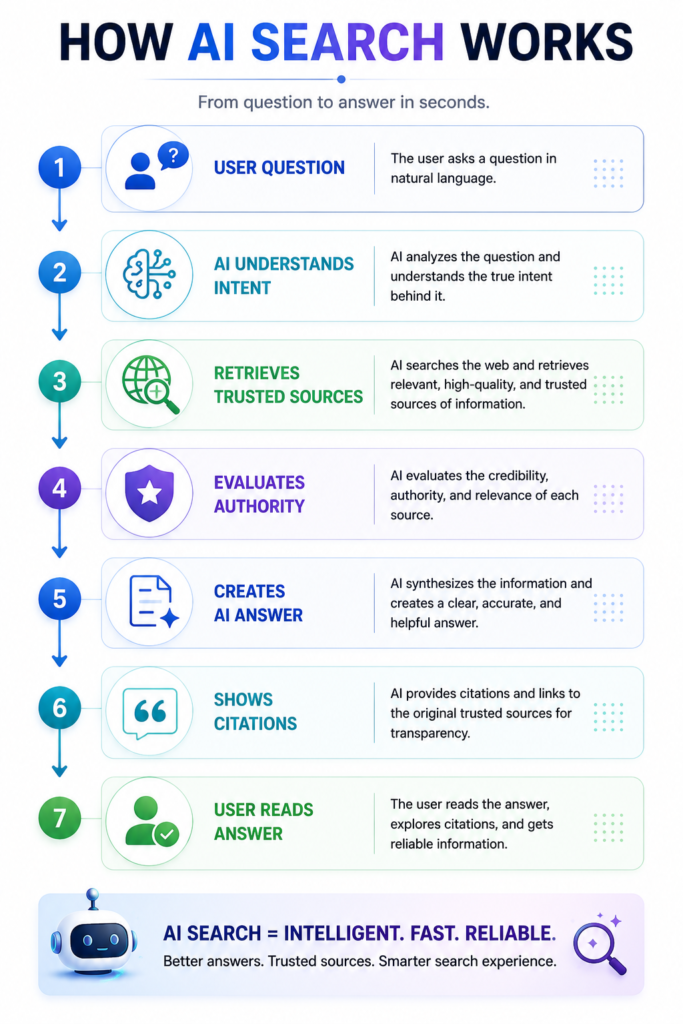
Step 1: Understanding User Intent
AI models interpret the meaning behind a query rather than matching keywords exactly.
For example:
Instead of searching:
AI SEO
A user may ask:
How can my business appear in ChatGPT search results?
AI understands that both queries relate to the same topic.
Step 2: Retrieving Relevant Information
Modern AI search engines retrieve information from multiple sources, including:
- Search indexes
- Trusted websites
- Knowledge graphs
- Structured databases
- Previously indexed documents
- High-authority publications
Step 3: Evaluating Authority
Before generating an answer, AI systems assess content quality using signals such as:
- Website authority
- Brand reputation
- Topical expertise
- Citation frequency
- Content freshness
- Author credibility
- User engagement
- Structured information
Step 4: Generating Responses
Instead of showing ten blue links, AI creates a summarized answer while often referencing its most trusted sources.
Being included in these citations is becoming just as valuable as ranking on page one.
What Platforms Should You Optimize For?
Many businesses assume AI SEO means optimizing only for ChatGPT.
In reality, AI SEO covers a growing ecosystem of AI-powered search platforms.
ChatGPT
ChatGPT Search provides conversational answers and increasingly includes references to authoritative websites. Businesses with strong topical authority and well-structured content have a higher chance of being surfaced in relevant responses.
Google AI Overviews
Google AI Overviews appear directly within Google Search and summarize information from multiple sources. Optimizing for AI Overviews requires comprehensive content, strong E-E-A-T signals, structured data, and clear answers to common questions.
Google Gemini
Gemini integrates deeply with Google’s ecosystem and benefits from websites that publish trustworthy, well-organized, and authoritative content.
Microsoft Copilot
Microsoft Copilot combines Bing Search with AI-generated responses. Strong technical SEO, Bing indexing, and high-quality content all contribute to better visibility.
Claude AI
Claude emphasizes factual accuracy, context, and reliable information. Publishing in-depth educational content increases the likelihood of being considered a valuable source.
Perplexity AI
Perplexity AI prominently cites websites within its responses. This makes authoritative content, original research, and clear explanations especially valuable.
Core Ranking Factors for AI SEO
Although AI platforms use different algorithms, most evaluate websites using similar quality signals.
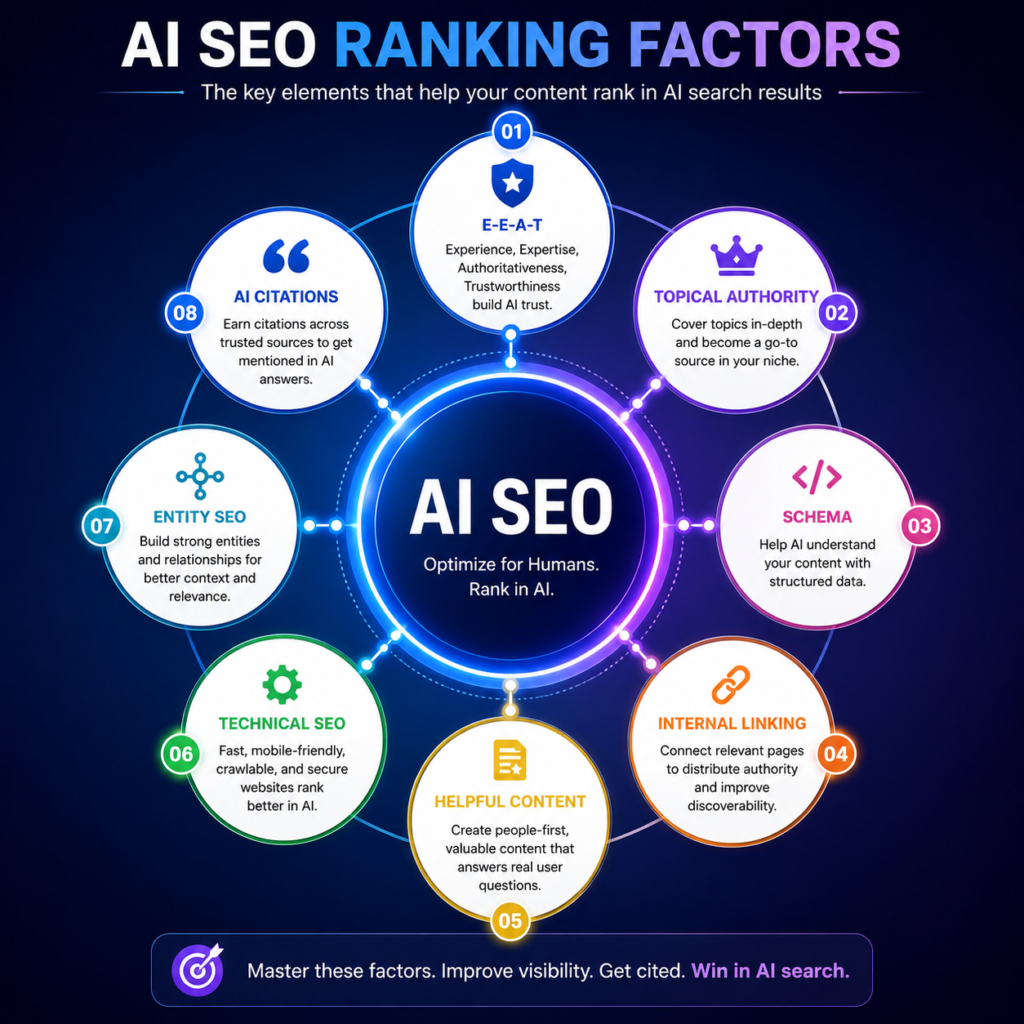
1. Topical Authority
Instead of publishing isolated articles, build comprehensive content clusters around a specific subject.
For example:
AI SEO
- What Is AI SEO?
- AI SEO Checklist
- ChatGPT SEO
- Google AI Overviews
- AI Citations
- LLM SEO
- AI Crawlers
- Structured Data for AI
- AI Search Optimization
This interconnected approach demonstrates expertise and increases the likelihood of becoming a trusted source.
2. E-E-A-T
Google’s Experience, Expertise, Authoritativeness, and Trustworthiness framework has become even more important in AI search.
Strengthen E-E-A-T by:
- Publishing expert-written content
- Including author bios
- Citing reputable sources
- Sharing original research
- Updating content regularly
- Displaying business credentials
- Earning mentions from trusted websites
3. Content Depth
AI systems favor comprehensive resources over thin content.
Instead of writing a 700-word overview, create detailed guides that answer every major question users may have about a topic.
Aim to become the definitive resource rather than simply another blog post.
How to Rank in ChatGPT, Google AI Overviews & AI Search Engines
Now that you understand what AI SEO is and why it matters, let’s dive into the practical strategies that can help your website appear in AI-generated answers.
Unlike traditional search engines, AI platforms don’t simply rank pages—they evaluate the overall quality, authority, and usefulness of your content before deciding whether to reference it.
The following strategies can significantly improve your visibility across ChatGPT, Google AI Overviews, Perplexity AI, Gemini, Claude, Microsoft Copilot, and future AI-powered search engines.
How to Rank in ChatGPT Search
As ChatGPT evolves into a search experience, businesses naturally want to know:
“How can my website appear in ChatGPT responses?”
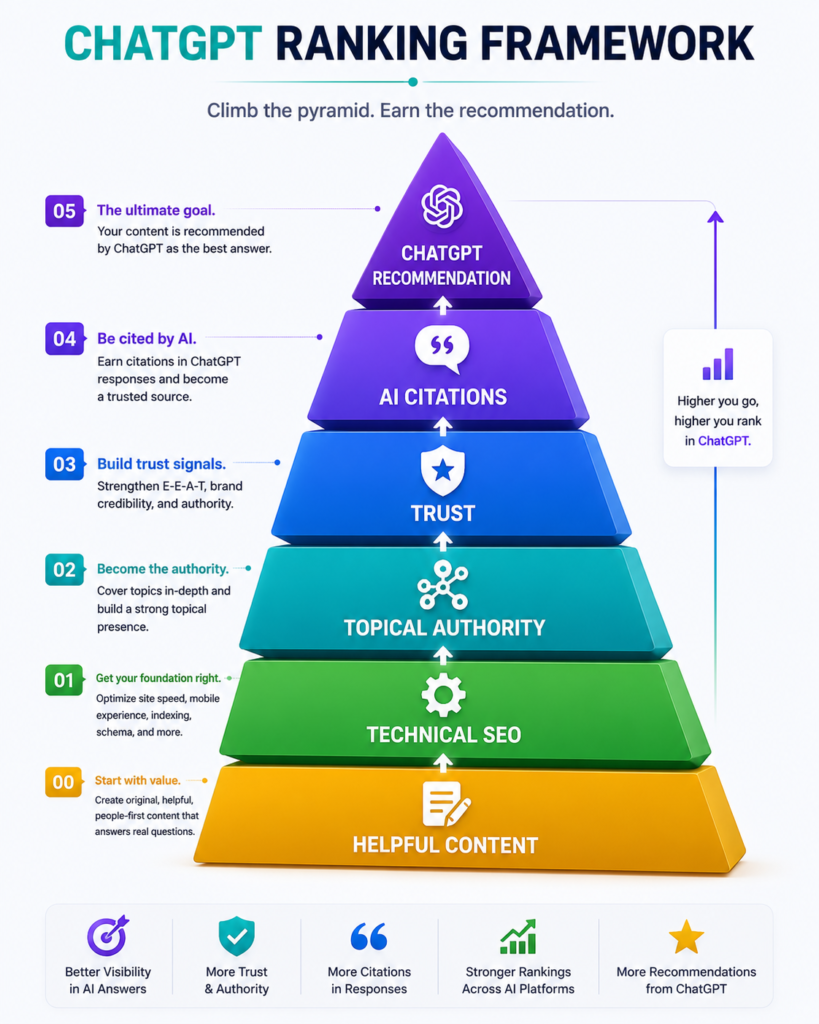
There isn’t a single “ChatGPT ranking algorithm,” but several factors consistently improve the chances that your content will be surfaced or cited.
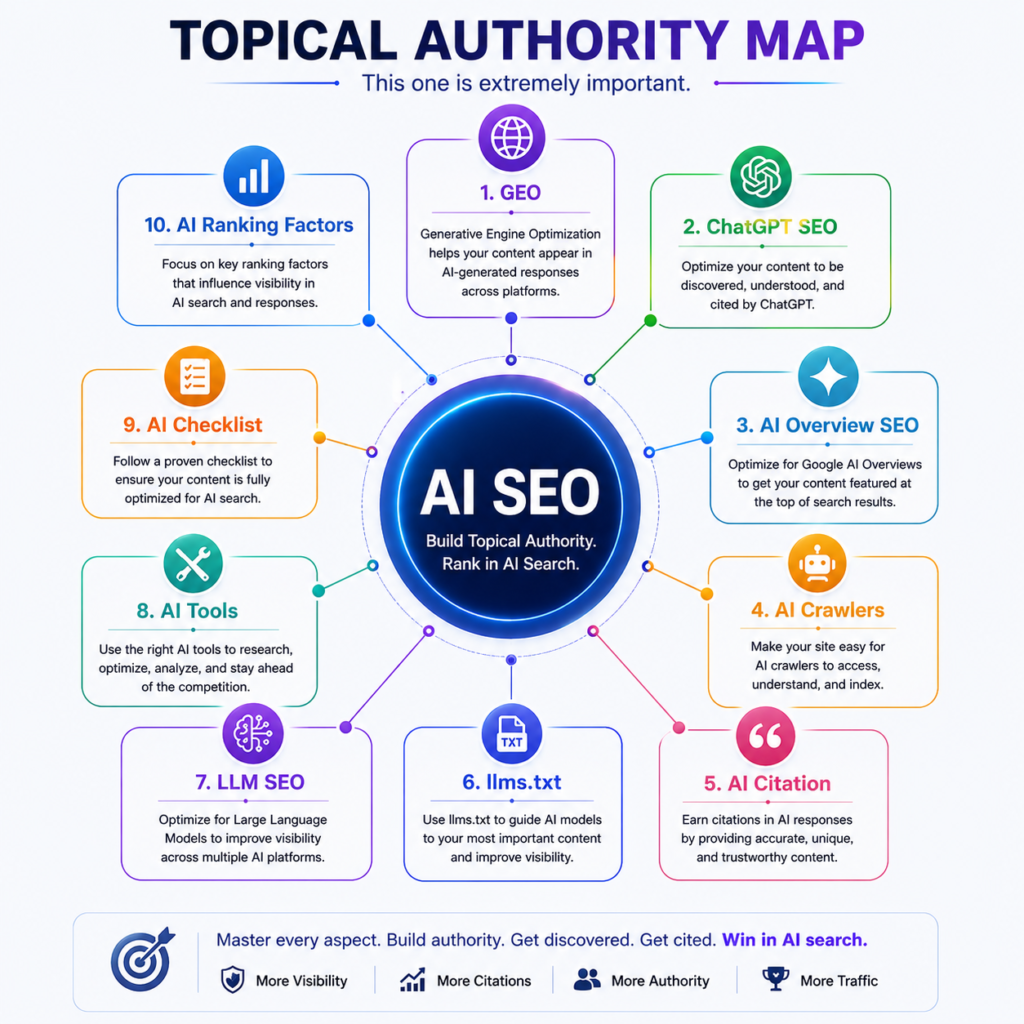
1. Build Topical Authority Instead of Publishing Random Blogs
One of the biggest mistakes businesses make is publishing unrelated content.
For example:
- SEO Basics
- Digital Marketing
- Instagram Tips
- Email Marketing
- Facebook Ads
This approach creates a broad blog without demonstrating deep expertise.
Instead, create topic clusters.
Example:
AI SEO Cluster
- Complete AI SEO Guide
- What is GEO?
- AI SEO Checklist
- ChatGPT SEO
- AI Crawlers
- AI Citations
- LLM SEO
- llms.txt Guide
- AI SEO Tools
- AI Search Ranking Factors
When AI systems consistently see your website covering one subject in depth, they are more likely to treat it as an authoritative source.
2. Answer Questions Naturally
AI models are designed around conversations, not just keywords.
Instead of writing:
AI SEO is important.
Write:
Why Is AI SEO Important?
AI SEO helps businesses optimize their websites for AI-powered search engines such as ChatGPT, Google AI Overviews, Gemini, Claude, and Perplexity. As users increasingly rely on conversational AI instead of traditional search engines, businesses that optimize for AI search can improve visibility, brand authority, and organic traffic.
Notice how the answer is direct, complete, and conversational.
This format is much easier for AI models to understand and reuse.
3. Cover Topics Completely
Thin content rarely performs well in AI search.
Instead of writing:
What is AI SEO?
Create sections such as:
- Definition
- Benefits
- Examples
- Best Practices
- Common Mistakes
- FAQs
- Future Trends
- Expert Tips
The more comprehensive your article, the more useful it becomes to both users and AI systems.
4. Demonstrate Real Experience
AI increasingly favors content that reflects genuine expertise.
Include:
- Client case studies
- Screenshots
- Original research
- Real campaign data
- Personal experience
- Industry observations
- Practical examples
Instead of saying:
AI SEO improves rankings.
Write:
At Web Marlins, we observed that websites with comprehensive topic clusters and strong internal linking were more likely to appear in AI-generated search experiences after consistently publishing high-quality content.
Original insights make your content more distinctive and valuable.
How to Optimize for Google AI Overviews
Google AI Overviews summarize information directly in Google Search.
Being featured can dramatically increase brand visibility, even if users don’t click through immediately.
Focus on Search Intent
Before writing any article, ask:
What is the user trying to accomplish?
For example:
Search:
AI SEO
Possible intentions include:
- Learn AI SEO
- Find AI SEO tools
- Hire an AI SEO agency
- Understand ranking factors
- Compare AI SEO with traditional SEO
Your article should satisfy every relevant intent.
Use Clear Heading Structures
Google prefers content that is easy to understand.
Example:
What Is AI SEO?
Benefits of AI SEO
How AI Search Works
AI SEO Checklist
Common Mistakes
FAQs
Avoid vague headings like:
“Let’s Talk About AI”
Clear headings improve readability for both humans and AI.
Use Lists and Tables
AI systems frequently extract structured information.
Example:
Benefits of AI SEO
- Better AI visibility
- More organic traffic
- Higher authority
- Increased brand mentions
- Better user experience
Tables also improve extraction.
| Traditional SEO | AI SEO |
|---|---|
| Keyword Focus | Topic Focus |
| Rankings | AI Citations |
| Clicks | Brand Visibility |
| SERPs | AI Answers |
Write Concise Definitions
Every important term should begin with a concise explanation.
Example:
AI Citation is the process by which AI search engines reference trusted websites when generating answers.
This increases the chance that your content will be quoted or summarized accurately.
How to Rank in Perplexity AI
Perplexity AI differs from many AI platforms because it openly cites the sources it uses.
To increase your chances of appearing:
Publish Original Research
Instead of repeating existing information, create:
- Industry reports
- Surveys
- Statistics
- Experiments
- Case studies
Original data is far more likely to earn citations.
Keep Content Updated
AI prefers current information.
Examples:
- AI SEO in 2026
- Latest Google AI Updates
- ChatGPT Search Changes
- New AI Ranking Factors
Refresh cornerstone articles regularly rather than letting them become outdated.
How to Optimize for Google Gemini
Gemini benefits from Google’s existing understanding of your website.
Best practices include:
- Strong technical SEO
- Helpful content
- Clear topical authority
- Fast-loading pages
- Mobile optimization
- Schema markup
- Internal linking
- Consistent publishing
If your website already performs well in Google Search, you’re building a solid foundation for Gemini visibility.
How to Optimize for Claude AI
Claude emphasizes factual accuracy and depth.
To improve your chances of being referenced:
- Cite authoritative sources
- Avoid exaggerated claims
- Explain concepts clearly
- Provide balanced viewpoints
- Update outdated content
- Include expert opinions where appropriate
Long-form educational resources tend to align well with Claude’s emphasis on reliable information.
How to Optimize for Microsoft Copilot
Microsoft Copilot combines AI with Bing Search.
Optimize by:
- Submitting your sitemap to Bing Webmaster Tools
- Following Bing SEO best practices
- Using structured data
- Improving page speed
- Creating high-quality content
- Building authoritative backlinks
Don’t overlook Bing—its ecosystem powers several AI experiences.
Conversational SEO: The Future of Search
Traditional keyword optimization remains useful, but users increasingly ask complete questions.
Instead of targeting:
AI SEO
Also optimize for:
- What is AI SEO?
- How does AI SEO work?
- Can AI improve SEO?
- How do I rank in ChatGPT?
- What is the difference between SEO and AI SEO?
- How do AI search engines rank websites?
- Which AI search engine is best?
Use these questions naturally throughout your content, especially in FAQs and section headings.
Build Semantic Relevance
AI models understand relationships between concepts.
If your article discusses AI SEO, it should also mention related topics such as:
- Generative Engine Optimization (GEO)
- Large Language Models (LLMs)
- Retrieval-Augmented Generation (RAG)
- Natural Language Processing (NLP)
- E-E-A-T
- Structured Data
- Schema Markup
- Search Intent
- Internal Linking
- Entity SEO
- AI Crawlers
- Knowledge Graphs
- Vector Search
Covering related concepts helps AI understand the full context of your content.
Create Content AI Can Easily Understand
Use simple formatting:
- Short paragraphs
- Bullet lists
- Comparison tables
- Numbered steps
- FAQs
- Definitions
- Key takeaways
Avoid large walls of text. Well-structured content is easier for both readers and AI systems to process.
AI SEO Best Practices Checklist
Before publishing any article, review this checklist:
- Target one primary keyword and several related semantic keywords.
- Match the content to user intent.
- Write clear definitions for important terms.
- Include practical examples and actionable advice.
- Build topical authority with supporting articles.
- Use descriptive H2 and H3 headings.
- Add relevant internal links.
- Include authoritative external references.
- Optimize title tags and meta descriptions.
- Add FAQ and Article schema where appropriate.
- Keep the content fresh with regular updates.
Following this process improves your chances of being understood and referenced by AI-powered search systems.
Advanced AI SEO Strategies: Technical Optimization, E-E-A-T, AI Crawlers & Future-Proofing Your Website
You’ve learned what AI SEO is and how to optimize your content for ChatGPT, Google AI Overviews, Perplexity AI, Gemini, Claude, and Microsoft Copilot. In this final section, we’ll cover the advanced strategies that can help establish your website as a trusted source for AI-powered search.
Technical AI SEO: Build a Strong Foundation
Great content alone isn’t enough. AI search engines still rely on many traditional technical SEO signals to discover, crawl, and understand your website.
1. Improve Website Speed
Fast-loading websites provide a better user experience and make it easier for search engines to crawl your content efficiently.
Best Practices
- Optimize images using next-generation formats (WebP/AVIF)
- Enable browser caching
- Minify CSS and JavaScript
- Use a Content Delivery Network (CDN)
- Reduce server response time
- Eliminate unnecessary third-party scripts
Recommended Core Web Vitals
- Largest Contentful Paint (LCP): Under 2.5 seconds
- Interaction to Next Paint (INP): Under 200 ms
- Cumulative Layout Shift (CLS): Under 0.1
2. Optimize Your Website Structure
A clear site structure helps both users and AI systems understand relationships between pages.
Example:
AI SEO
│
├── What is AI SEO?
├── ChatGPT SEO
├── Google AI Overviews
├── Perplexity SEO
├── AI Citations
├── LLM SEO
├── AI SEO Checklist
└── AI SEO Tools
This structure strengthens topical authority.
3. Create Topic Clusters
Instead of publishing unrelated blogs, organize content around one pillar page with multiple supporting articles.
Example:
Pillar
- Complete AI SEO Guide
Supporting Articles
- What Is GEO?
- AI SEO Checklist
- ChatGPT SEO
- Google AI Overviews SEO
- AI Crawlers
- llms.txt Guide
- AI Citation Optimization
- AI SEO Tools
Every article should:
- Link to the pillar page.
- Link to at least three related articles.
- Use descriptive anchor text.
Schema Markup: Help AI Understand Your Content
Structured data gives search engines additional context about your content.
For AI SEO, consider implementing:
- Article Schema
- FAQ Schema
- Organization Schema
- Person Schema
- Breadcrumb Schema
- HowTo Schema (when applicable)
- WebPage Schema
Benefits include:
- Better understanding of page content.
- Eligibility for rich search results.
- Improved visibility in AI-powered search experiences.
E-E-A-T: The Cornerstone of AI SEO
AI systems increasingly evaluate the trustworthiness of information before presenting it to users.
Strengthen your E-E-A-T by focusing on the following areas.
Experience
Show that the content is based on real-world work.
Examples:
- Share campaign results.
- Include screenshots.
- Explain lessons learned.
- Add practical examples.
Expertise
Demonstrate subject matter knowledge by publishing in-depth, accurate, and well-researched content.
Authoritativeness
Build your reputation by:
- Earning backlinks from trusted websites.
- Publishing original research.
- Speaking at industry events.
- Being mentioned by reputable publications.
Trustworthiness
Increase trust by:
- Displaying author information.
- Including business contact details.
- Using HTTPS.
- Maintaining transparent editorial policies.
- Keeping content updated.
What Is llms.txt?
The llms.txt file is an emerging concept designed to help AI systems identify useful resources on your website.
Although it isn’t an official ranking factor, some publishers use it to highlight:
- Documentation
- Product pages
- Knowledge bases
- Research content
- AI-friendly resources
Think of it as a potential way to make important content easier for AI systems to discover as standards evolve.
Understanding AI Crawlers
Different AI platforms may use their own crawling or retrieval methods.
Examples include systems associated with:
- OpenAI
- Microsoft
- Anthropic
- Perplexity
To ensure your content remains accessible:
- Don’t accidentally block important resources in
robots.txt. - Keep XML sitemaps updated.
- Use clean URLs.
- Fix crawl errors promptly.
- Avoid duplicate content.
The Importance of Internal Linking
Internal links help AI systems understand the relationships between your content.
For example:
Complete AI SEO Guide
- ChatGPT SEO
- Google AI Overviews SEO
- AI Citation Guide
- LLM SEO
- AI Crawlers
- AI SEO Tools
This creates a semantic network that reinforces topical authority.
Publish Original Research
One of the strongest AI SEO advantages is creating information that doesn’t exist elsewhere.
Ideas include:
- AI SEO industry surveys
- Ranking factor studies
- User behavior reports
- Original statistics
- Case studies
- Tool comparisons
- Experiments with AI search visibility
Original research is more likely to be referenced by AI systems and cited by other websites.
Optimize for Entity SEO
AI models understand entities (people, brands, organizations, places, products, and concepts) rather than just keywords.
Clearly define:
- Your company
- Your services
- Your authors
- Products
- Locations
- Industry terminology
Maintain consistent information across:
- Your website
- Google Business Profile
- Industry directories
- Social profiles
Consistency strengthens entity recognition.
AI SEO Tools You Should Use
A practical AI SEO workflow often includes:
| Tool | Primary Purpose |
|---|---|
| Google Search Console | Performance, indexing, technical issues |
| Google Analytics 4 | User behavior and conversions |
| Bing Webmaster Tools | Bing indexing and visibility |
| Ahrefs | Backlink analysis and keyword research |
| Semrush | SEO audits and competitive research |
| Screaming Frog | Technical SEO crawling |
| ChatGPT | Content planning and ideation |
| Google Gemini | Research and brainstorming |
| Claude | Long-form writing and refinement |
| Perplexity AI | Research with source citations |
Remember: AI tools should enhance your workflow—not replace expert review.
Common AI SEO Mistakes to Avoid
Avoid these common pitfalls:
1. Publishing Thin Content
Short, shallow articles rarely establish authority.
2. Ignoring User Intent
Answer the questions users are actually asking.
3. Overusing AI-Generated Content
Always review, fact-check, and add unique insights.
4. Weak Internal Linking
Support every pillar page with relevant cluster content.
5. Outdated Information
Refresh cornerstone content regularly.
6. Keyword Stuffing
Write naturally. Prioritize clarity over repetition.
7. No Original Value
If your article simply repeats what others have written, it is less likely to stand out.
How to Measure AI SEO Success
Traditional metrics remain valuable, but AI SEO introduces additional indicators.
Track:
- Organic traffic
- Keyword rankings
- AI Overview appearances (where measurable)
- Brand mentions
- Referral traffic
- Backlink growth
- Time on page
- User engagement
- Conversion rates
- Returning visitors
Monitor which articles consistently earn visibility and expand those topic clusters over time.
Future of AI SEO
AI search will continue to evolve, but several trends are becoming clear:
- Conversational search will become the norm.
- Entity-based optimization will grow in importance.
- Original research will gain more visibility.
- Comprehensive topic clusters will outperform isolated articles.
- User trust and brand authority will matter more than ever.
- Technical SEO will remain essential.
- Human expertise will continue to differentiate high-quality content from generic AI-generated pages.
Businesses that invest in authoritative, user-focused content today will be better positioned for the future of search.
Frequently Asked Questions (FAQs)
What is AI SEO?
AI SEO is the practice of optimizing websites and content so they can be understood, trusted, and referenced by AI-powered search systems such as ChatGPT, Google AI Overviews, Gemini, Claude, and Perplexity.
Is AI SEO different from traditional SEO?
Yes. Traditional SEO focuses on ranking webpages in search results, while AI SEO focuses on becoming a trusted source for AI-generated answers. The two approaches complement each other.
How do I rank in ChatGPT?
There is no guaranteed ranking system, but improving topical authority, publishing high-quality content, demonstrating E-E-A-T, using structured data, and answering user questions clearly can improve your visibility.
Does Google AI Overviews replace SEO?
No. AI Overviews build on Google’s existing search systems. Strong SEO practices remain essential, but content must also be comprehensive, trustworthy, and well-structured.
Can AI-generated content rank?
Yes, but only if it provides real value. AI-generated drafts should be reviewed, fact-checked, expanded with original insights, and edited by subject matter experts.
What are AI citations?
AI citations are references to websites that AI platforms use when generating answers. Being cited can increase visibility, authority, and brand recognition.
Is structured data important for AI SEO?
Yes. Schema markup helps search engines better understand your content and can improve eligibility for enhanced search features.
What is topical authority?
Topical authority is built by publishing multiple high-quality articles around one subject and linking them together to demonstrate expertise.
Which AI search engines should I optimize for?
Focus on ChatGPT, Google AI Overviews, Gemini, Microsoft Copilot, Claude, and Perplexity AI, while maintaining strong traditional SEO fundamentals.
How often should I update AI SEO content?
Review cornerstone content every three to six months or whenever significant AI search changes occur.
AI SEO Checklist
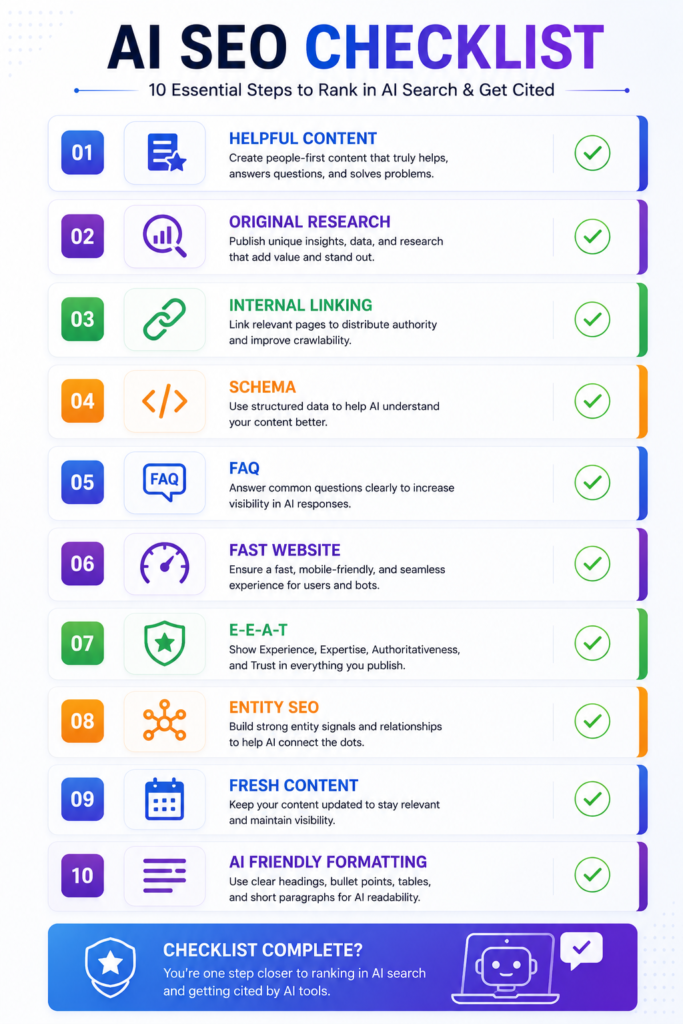
Before publishing, ensure your content:
- Targets a clear primary topic.
- Covers the subject comprehensively.
- Answers common user questions.
- Demonstrates real expertise.
- Includes internal and external links.
- Uses descriptive headings.
- Implements relevant schema markup.
- Is mobile-friendly and fast.
- Is updated regularly.
- Provides unique value beyond what’s already available.
AI Search Engine Comparison
Place after
What Platforms Should You Optimize For?
| Platform | Uses Live Web | Shows Citations | Best Optimization |
|---|---|---|---|
| ChatGPT | Yes | Yes | Topical Authority |
| Google AI Overviews | Yes | Yes | Helpful Content |
| Gemini | Yes | Partial | Technical SEO |
| Claude | Limited | Sometimes | Authority |
| Perplexity | Yes | Always | Original Research |
| Copilot | Yes | Yes | Bing SEO |
Final Thoughts
AI-powered search is changing how users discover information, but the core principle remains the same: create genuinely helpful, trustworthy, and authoritative content.
Businesses that combine strong technical SEO, comprehensive topical authority, E-E-A-T, structured data, and original insights will be best positioned to earn visibility across ChatGPT, Google AI Overviews, Gemini, Claude, Perplexity, and future AI search experiences.
Rather than chasing shortcuts or algorithm changes, focus on becoming the most reliable resource in your niche. That’s the strategy most likely to succeed—regardless of how search evolves.

Amir Siddiqui is a Digital Marketing Expert and SEO Specialist with over 8 years of experience helping businesses grow through data-driven digital marketing strategies. As the Founder of Web Marlins Pvt. Ltd., his core expertise lies in Search Engine Optimization (SEO), including Technical SEO, Local SEO, AI SEO, and content strategy. He has helped businesses across India, the USA, and the UAE improve search rankings, increase organic traffic, and generate high-quality leads through sustainable, results-focused SEO solutions.