
Updated: July 31, 2026
If you’ve been doing SEO for more than a few years, you already know the truth: most “web 2.0 backlink” tactics from 2015 are dead. Mass-created blogs stuffed with spun content and exact-match anchors don’t just fail to rank in 2026 — they can actively hurt you.
But here’s the part most people miss. Web 2.0 platforms themselves are far from dead. Used correctly, they remain one of the few genuinely free ways to build brand visibility, diversify your link profile, speed up indexing, and — increasingly important in 2026 — get your brand cited by AI search engines and LLMs, which frequently pull from high-authority user-generated platforms.
This guide gives you a verified, working list of web 2.0 submission sites for 2026, plus the strategy that separates the marketers who get results from the ones who waste weekends creating empty Blogger profiles.
What Are Web 2.0 Submission Sites?
Web 2.0 sites are platforms that let users publish their own content on an established, high-authority domain — instead of building a standalone website. You create a blog, mini-site, or profile on platforms like WordPress.com, Medium, or Blogger, publish content, and include contextual links back to your main website.
Because these platforms carry high Domain Authority (often DA 80–99), pages published on them tend to get crawled and indexed quickly, and links from them add natural diversity to your backlink profile.
Do Web 2.0 Sites Still Work for SEO in 2026?
Yes — with three big caveats:
- They work as supporting assets, not ranking shortcuts. The best use of web 2.0 properties in 2026 is as Tier 2 assets: pages that support and point to your strongest Tier 1 links (guest posts, digital PR mentions, resource pages) and to your money pages.
- Most web 2.0 links are nofollow or UGC-tagged. Google treats these as hints, not commands, and a natural profile should contain them. Medium links, for example, are nofollow — but they drive real referral traffic and brand signals.
- Quality standards have changed completely. Google’s spam policies and E-E-A-T emphasis mean thin, duplicated, link-stuffed pages get ignored or deindexed. Original, genuinely useful content is the price of entry.
One more 2026-specific reason to care: AI assistants and answer engines regularly cite content from Medium, LinkedIn, Quora, GitHub, and similar platforms. A well-maintained web 2.0 presence is now a visibility play, not just a link play.
Read Also: Web 2.0 SEO: A Complete Guide to Modern Optimization
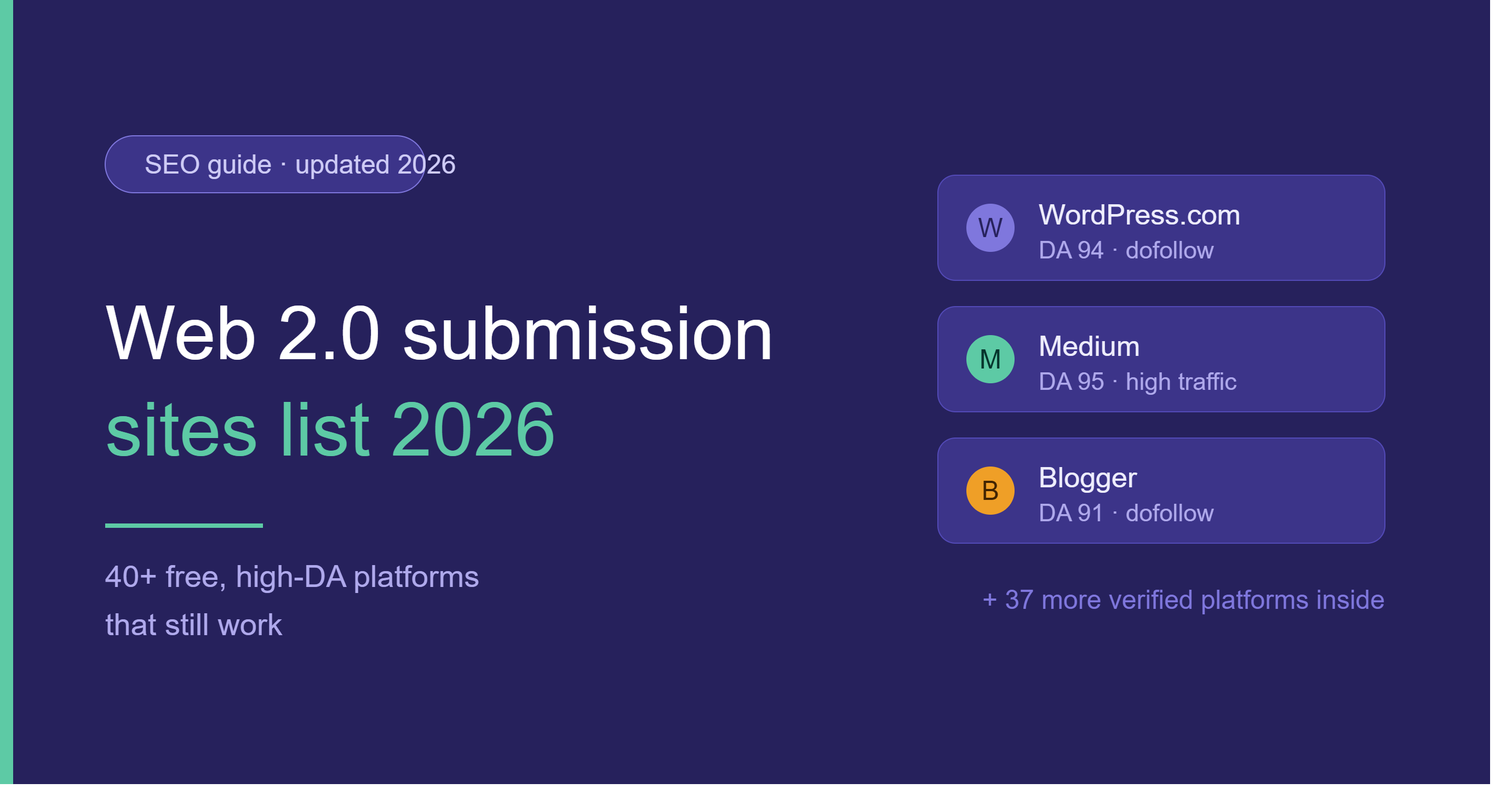
Web 2.0 Submission Sites List 2026 (Verified & Working)
All platforms below allow free account creation and publishing, and are actively indexed as of 2026. DA figures are approximate Moz Domain Authority scores and change over time.
Top-Priority Blogging Platforms (Start Here)
| # | Platform | URL | DA | Link Type |
|---|---|---|---|---|
| 1 | WordPress.com | wordpress.com | 94 | Dofollow |
| 2 | Blogger | blogger.com | 91 | Dofollow |
| 3 | Medium | medium.com | 95 | Nofollow* |
| 4 | Tumblr | tumblr.com | 86 | Nofollow |
| 5 | LiveJournal | livejournal.com | 92 | Nofollow |
| 6 | Substack | substack.com | 91 | Mixed |
| 7 | Ghost | ghost.org | 91 | Dofollow |
| 8 | Hashnode | hashnode.com | 79 | Dofollow |
| 9 | Dev.to | dev.to | 84 | Mixed |
| 10 | Write.as | write.as | 72 | Dofollow |
*Medium links are nofollow, but the referral traffic and brand authority make it worth prioritizing anyway.
Website & Mini-Site Builders
| # | Platform | URL | DA |
|---|---|---|---|
| 11 | Google Sites | sites.google.com | 96 |
| 12 | Wix | wix.com | 94 |
| 13 | Weebly | weebly.com | 92 |
| 14 | Strikingly | strikingly.com | 84 |
| 15 | Jimdo | jimdo.com | 89 |
| 16 | Webflow | webflow.com | 91 |
| 17 | Yola | yola.com | 80 |
| 18 | Site123 | site123.com | 78 |
| 19 | Carrd | carrd.co | 82 |
| 20 | Mystrikingly | mystrikingly.com | 74 |
Publishing, Docs & Portfolio Platforms
| # | Platform | URL | DA |
|---|---|---|---|
| 21 | Notion (public pages) | notion.so | 91 |
| 22 | GitHub Pages | github.io | 96 |
| 23 | GitLab Pages | gitlab.io | 87 |
| 24 | Behance | behance.net | 92 |
| 25 | Dribbble | dribbble.com | 91 |
| 26 | Issuu | issuu.com | 94 |
| 27 | SlideShare | slideshare.net | 95 |
| 28 | Telegraph | telegra.ph | 85 |
| 29 | Google Docs (public) | docs.google.com | 98 |
| 30 | Canva (public designs) | canva.com | 94 |
Community, Q&A & Social Publishing
| # | Platform | URL | DA |
|---|---|---|---|
| 31 | LinkedIn Articles | linkedin.com | 98 |
| 32 | Quora (Spaces & answers) | quora.com | 93 |
| 33 | Reddit (relevant subreddits) | reddit.com | 96 |
| 34 | pinterest.com | 94 | |
| 35 | Vocal Media | vocal.media | 78 |
| 36 | HubPages | hubpages.com | 84 |
| 37 | Steemit | steemit.com | 81 |
| 38 | Minds | minds.com | 76 |
| 39 | Diigo | diigo.com | 85 |
| 40 | flipboard.com | 92 |
A note on churn: platforms shut down, change link policies, and tighten spam filters constantly. Before investing serious time in any platform, spend two minutes confirming account creation works and that recent posts from the platform appear in Google via a site: search.
Read Also: Global Free Business Listing Sites in India
How to Use Web 2.0 Sites the Right Way (2026 Strategy)
1. Build 8–12 properties, not 300. Pick platforms relevant to your niche. A designer belongs on Behance and Dribbble; a SaaS founder belongs on Medium, Dev.to, and LinkedIn. Spreading across 300 sites is a spam signal and a time sink.
2. Roll out slowly. Create properties over 60–90 days, not one weekend. Sudden bursts of near-identical new blogs all linking to one domain is exactly the footprint Google’s spam systems are trained to catch.
3. Publish original content only. Every post should be unique — no spinning, no republishing the same article across ten platforms. Aim for 800+ words of genuinely useful, niche-relevant content per post.
4. Treat each property like a real publication. Complete the profile (bio, photo, links), publish on a recurring schedule (1–2 posts per platform per month is plenty), and let each property build its own topical relevance.
5. Link naturally. One or two contextual links per post, mixed anchors (brand name, naked URL, long-tail phrases), and plenty of posts with no link to your site at all. Also link out to authoritative third-party sources — real blogs do.
6. Interlink your properties. Let your web 2.0 assets reference each other where it makes sense, forming a natural content ecosystem around your brand rather than a hub-and-spoke link wheel.
7. Point web 2.0 links at the right targets. The highest-value use in 2026 is Tier 2: strengthening your guest posts, PR mentions, and cornerstone content — not blasting links at a thin product page.
Common Mistakes That Kill Web 2.0 Campaigns
- Publishing duplicate or AI-spun content across multiple platforms
- Using exact-match keyword anchors on every link
- Creating dozens of properties in a single week
- Abandoning properties after one post (dead blogs = zero value)
- Ignoring nofollow platforms like Medium that drive real traffic
- Chasing quantity (“300+ sites!”) instead of depth on 8–12 relevant ones
FAQ
Are web 2.0 backlinks safe in 2026?
Yes, when built manually with original content and natural anchors. Automated mass submission is what gets sites penalized, not the platforms themselves.
Are web 2.0 links dofollow or nofollow?
Mixed. WordPress.com, Blogger, and most site builders allow dofollow links; Medium, Tumblr, and most social platforms are nofollow. A healthy profile includes both.
How many web 2.0 sites should I use?
Start with 5–10 in your first month and grow from there. Depth beats breadth every time — one active, well-written Medium publication outperforms twenty empty Blogger profiles.
How long until I see results?
Web 2.0 links are a supporting tactic, not a primary ranking lever. Expect gradual gains in indexing speed, referral traffic, and link diversity over 2–4 months — compounding with your Tier 1 link building.
Final Thoughts
The web 2.0 submission sites list above is maybe 20% of the equation. The other 80% is execution: choosing a handful of relevant platforms, publishing content people actually want to read, and linking like a publisher rather than a spammer. Do that consistently for 90 days, and these free, high-authority platforms will quietly do what they’ve always done best — extend your brand’s reach, diversify your backlink profile, and give search engines (and now AI engines) more reasons to trust you.

Amir Siddiqui is a Digital Marketing Expert and SEO Specialist with over 8 years of experience helping businesses grow through data-driven digital marketing strategies. As the Founder of Web Marlins Pvt. Ltd., his core expertise lies in Search Engine Optimization (SEO), including Technical SEO, Local SEO, AI SEO, and content strategy. He has helped businesses across India, the USA, and the UAE improve search rankings, increase organic traffic, and generate high-quality leads through sustainable, results-focused SEO solutions.