
Updated: August 17, 2026
Ask ChatGPT to recommend a digital marketing agency in Delhi and it will name a handful of companies. It will not name the other four hundred. Nobody at OpenAI sat down and picked those winners, and none of them paid for the placement.
So how does ChatGPT choose websites? It is not doing what Google does. There is no ranked list of ten blue links being quietly reordered behind the scenes. ChatGPT pulls information from a few different places, evaluates what it finds, and quotes only the sources that best answer the specific question in front of it.
Understanding that process is the difference between guessing at AI visibility and working on it deliberately. This guide walks through where ChatGPT actually gets its information, what it appears to weigh when selecting sources, why ranking first on Google does not guarantee you a mention, and what you can practically do about it.
One honest note before we start. OpenAI has not published its full source selection logic, and it may never do so. Everything below combines what OpenAI does document publicly with correlation studies from the AI visibility industry. Treat the documented mechanics as reliable and the statistical patterns as directional.
The Short Answer: How ChatGPT Chooses Websites
ChatGPT decides which websites to recommend by first working out whether it needs to search the live web at all, then retrieving a set of candidate pages, then evaluating those pages for relevance, trustworthiness and how cleanly an answer can be lifted from them. It quotes only the small handful that survive that evaluation.
The critical shift in thinking is this. Google ranks pages against each other. ChatGPT selects and synthesises. You are not competing for a position on a list. You are competing to be included in a paragraph.
Where ChatGPT Actually Gets Its Information
There are three distinct pathways, and they behave very differently. Most confusion about ChatGPT search comes from treating them as one thing.
1. Training Data
The model was trained on an enormous volume of text from the internet up to a cutoff date. If your brand has a long, consistent presence online, this works quietly in your favour. It is why ChatGPT can name well established companies in a category without searching at all.
You cannot optimise this directly and you cannot influence it quickly. It rewards years of consistent presence, not a campaign.
2. Live Web Search
When a question needs current information, ChatGPT triggers a live search. This runs on a combination of Bing’s search index and OpenAI’s own crawler, OAI-SearchBot.
That dependency has a very practical consequence that a surprising number of businesses miss. If your site is not indexed in Bing, or if you have blocked OAI-SearchBot, you can be completely invisible inside ChatGPT while ranking beautifully on Google. Most SEO teams have never opened Bing Webmaster Tools. That is a free, unclaimed advantage sitting on the table.
3. User Triggered Fetching
If someone pastes a URL into ChatGPT and asks it to read the page, a different agent fetches that specific page. This behaves more like a browser visit than a crawl. It matters less for discovery, but it is why a page that is heavily dependent on JavaScript can appear broken or empty to the model.
The Four Steps ChatGPT Takes Before It Recommends a Website
For any query that triggers a live search, the process typically runs like this.
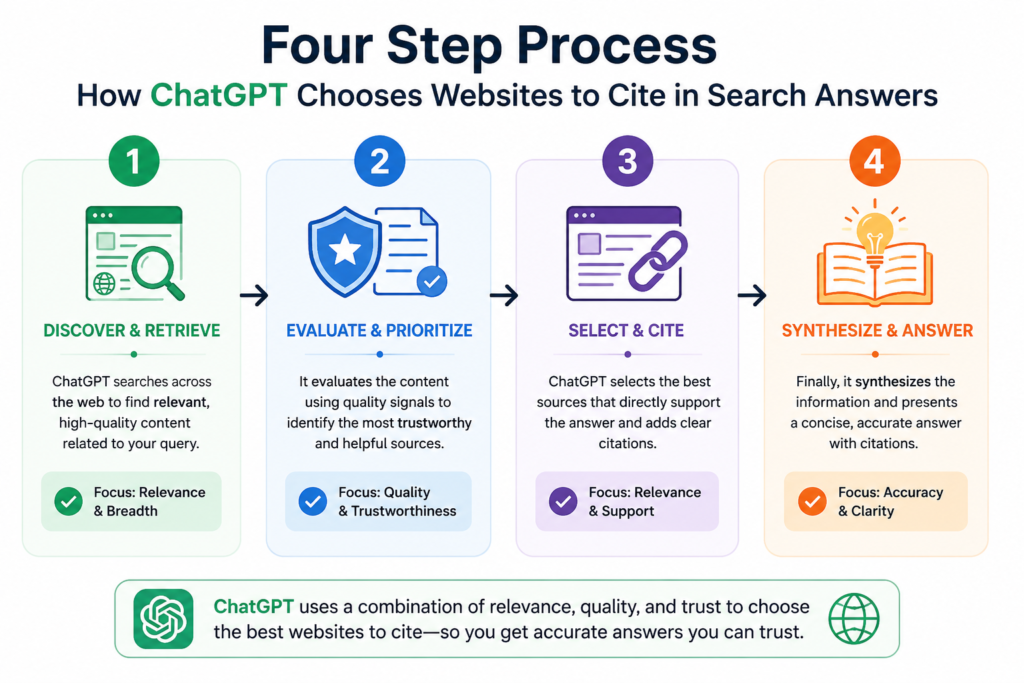
Step 1: Understand the question. The model interprets what is actually being asked, including intent. “What is answer engine optimization” and “who is the best answer engine optimization company” require completely different sources even though they share vocabulary.
Step 2: Retrieve candidates. ChatGPT often breaks one prompt into several narrower searches rather than running your exact wording as a single query. This is important. You are not optimising for one phrase. You are optimising for a cluster of sub-questions the model generates on its own.
Step 3: Evaluate what it found. Candidate pages get assessed for relevance to the specific sub-question, credibility of the source, and how easily a clean, accurate statement can be extracted.
Step 4: Cite selectively. Only a few sources make the final answer. Typical browsing responses surface roughly three to six citations. Analysis from the AI visibility industry suggests ChatGPT discards the large majority of pages it retrieves without ever showing them, which means retrieval is the easy part and surviving evaluation is the real contest.
What Influences ChatGPT Citations
No single factor decides this. Several signals appear repeatedly across independent analyses.
Domain Authority and Referring Domains
Site level authority remains one of the strongest observed predictors. Research from Profound found that a site with more than 32,000 referring domains was around 3.5 times more likely to be cited than a site with fewer than 200.
That sounds discouraging if you are a small business, and it should be read carefully. It is a correlation across large datasets, not a threshold you must cross. Plenty of small, highly specific sites get cited for narrow questions that large sites never bothered to answer properly. Authority helps most for broad, competitive queries. Specificity wins the narrow ones. Our guide to building authority backlinks covers the long game here.
Freshness
This one is unusually strong. Profound’s analysis found that close to 90% of cited pages had been updated within the previous year, and pages updated within the previous three months were cited significantly more often.
The practical implication is uncomfortable but useful. A competitor’s guide updated last week can beat your more authoritative guide from last year on the same topic. A refresh cadence is not housekeeping any more. It is a visibility tactic.
Extractability and Structure
ChatGPT needs to lift a clean statement off your page. Content that leads with a direct answer under a clear heading gets quoted more often than content that builds to its point over six paragraphs.
Put the answer in the first two sentences under each heading, then explain underneath. Use question shaped subheadings. Add FAQ and Article schema. Keep paragraphs short. Your heading hierarchy does real work here because it tells the model where an answer begins and ends, which is why header tags matter more now than they did five years ago.
Fact Density and Original Data
Pages carrying verifiable statistics with named sources, original research and attributed expert quotes get cited more than pages of general advice. A model synthesising an answer needs something specific to attribute to you. If your page contains nothing that only you could have written, there is no reason to name you rather than anyone else.
Off-Site Mentions
Credibility is not built only on your own website. Consistent mentions of your brand across directories, review platforms, industry publications, forums and social profiles feed the entity understanding that AI systems rely on. Being described the same way everywhere makes you a confident thing to cite.
Why Ranking on Google Does Not Guarantee ChatGPT Recommends You
This is the finding that surprises most business owners. Ahrefs analysed URLs cited by ChatGPT, Gemini and Copilot and found only around 12% of them also ranked in Google’s top 10 for the same prompt.
Read that again, because it cuts both ways. Your Google rankings do not automatically carry over into ChatGPT ranking or citations. But it also means a business that has never cracked page one on Google can still get recommended inside AI answers.
The overlap is partial for a reason. ChatGPT is not looking for the most authoritative page overall. It is looking for the page that answers this specific sub-question most cleanly, from a source it has reason to trust, updated recently enough to be safe to quote. Those are related to ranking factors but they are not the same thing. We cover the wider strategic picture in AI SEO vs SEO and the full optimisation playbook in our ChatGPT search optimization guide.
Technical Checklist: Make Sure ChatGPT Can See You At All
Before optimising anything, confirm you are not accidentally invisible. This takes about an hour.
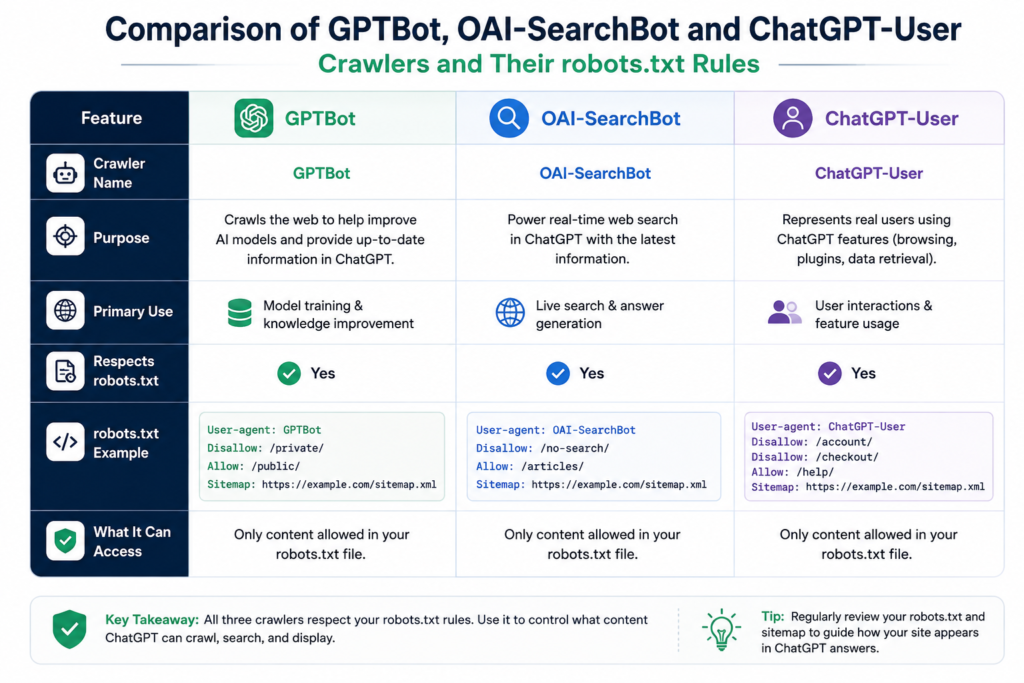
- Check your robots.txt for OAI-SearchBot. OpenAI runs separate crawlers for separate jobs. GPTBot handles model training, OAI-SearchBot builds the search index that powers citations, and ChatGPT-User handles user triggered fetches. Blocking GPTBot keeps your content out of training while leaving citations intact. Blocking OAI-SearchBot removes you from ChatGPT search answers entirely. Many sites blocked all OpenAI bots in 2024 without understanding the distinction, and never revisited it.
- Claim Bing Webmaster Tools and submit your sitemap. ChatGPT’s live search leans on Bing’s index. If Bing cannot see you, ChatGPT largely cannot either.
- Do not noindex or nosnippet pages you want quoted. If a page cannot show a snippet in normal search, it generally cannot be cited in an AI answer.
- Server render your important content. If your answer only appears after heavy client side JavaScript, many crawlers never see it. This catches a lot of modern single page sites.
- Keep key content out from behind paywalls and logins. Restricted pages are generally skipped.
- Check for accidental blocks at the CDN or firewall level. Security teams sometimes block AI bots broadly without telling marketing.
How to Check Whether ChatGPT Recommends Your Website
There is still no universal dashboard for this, so build a simple manual process.
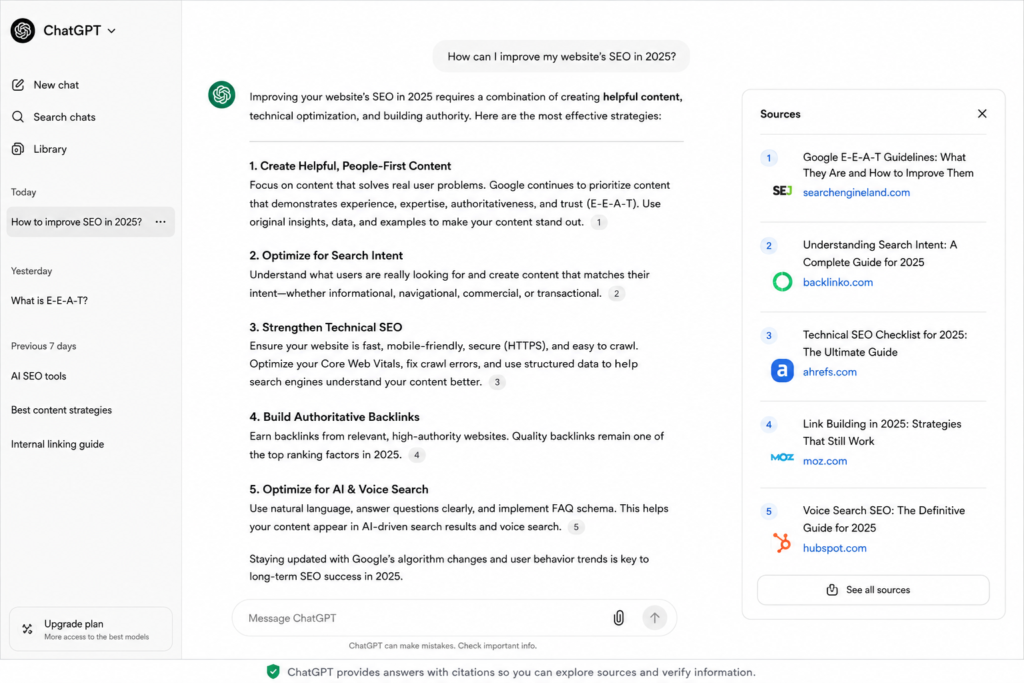
Write down 20 to 30 prompts your customers would realistically type before buying from you. Include category questions, comparison questions, “best X in Y city” questions and problem questions. Run them in ChatGPT once a month with search enabled and log whether your brand appears and which page gets cited.
Alongside that, isolate AI referral traffic in GA4. ChatGPT referrals typically carry a chatgpt.com source parameter, which gives you a clean way to separate this traffic instead of letting it disappear into “direct.” Watch branded search volume too. A rise in people googling your company name is a real signal even when the AI answer produced no click.
Judge all of this on a monthly trend. AI answers are probabilistic, so the same prompt can return different sources on different days. A single test tells you very little.
What This Means for Your Business
The businesses getting recommended by ChatGPT are not the ones that found a trick. They are the ones that are technically visible to the right crawlers, described consistently across the web, publishing something specific enough to be worth quoting, and updating it often enough to stay safe to cite.
None of that is exotic. Most of it overlaps heavily with good traditional SEO pointed at a slightly different target. The gap is that very few businesses have checked the technical basics, and almost none have a refresh cadence.
Start here this week: open ChatGPT, ask it the five questions your best customers ask before they buy, and note which businesses get named. Then check your robots.txt for OAI-SearchBot. Those two steps cost nothing and will tell you more about your AI visibility than any tool will.
If you want a team to run this properly across both search and AI answers, explore our SEO services and our work in generative engine optimization, or get in touch for an audit of where you currently stand.
Frequently Asked Questions
How does ChatGPT choose which websites to recommend?
ChatGPT first determines whether the question needs live web information. If it does, it retrieves candidate pages using Bing’s index and its own OAI-SearchBot crawler, evaluates them for relevance, credibility and how cleanly an answer can be extracted, then cites only the few sources that best support its final answer. It selects and synthesises rather than ranking a list.
Does ChatGPT use Google or Bing?
ChatGPT’s live search leans on Bing’s index combined with OpenAI’s own crawler, OAI-SearchBot. It does not use Google’s index. This is why a site can rank well on Google and still be missing from ChatGPT answers, and why claiming Bing Webmaster Tools is a practical first step.
Why is my website not showing up in ChatGPT?
The most common causes are technical. Your robots.txt may block OAI-SearchBot, your site may not be indexed in Bing, your content may only render after JavaScript loads, or key pages may be behind a login or paywall. Beyond that, your content may simply not answer the specific question clearly enough near the top of the page.
Does ranking on Google mean ChatGPT will cite me?
No. Ahrefs found only around 12% of URLs cited by ChatGPT, Gemini and Copilot also ranked in Google’s top 10 for the same prompt. Strong Google rankings help but do not transfer automatically, and businesses that do not rank on page one can still be cited in AI answers.
How many sources does ChatGPT cite in an answer?
Browsing responses typically surface around three to six citations, though deeper research modes pull from far more. ChatGPT retrieves considerably more pages than it displays and discards most of them, so appearing in the retrieved set is not the same as being cited.
Does blocking GPTBot stop ChatGPT from citing my website?
No. GPTBot governs whether your content can be used for model training. ChatGPT search citations come through OAI-SearchBot, which is a separate robots.txt rule. You can block training while remaining fully citable, but blocking OAI-SearchBot removes you from ChatGPT search answers.
How often should I update content to stay cited by ChatGPT?
Freshness is a strong signal. Profound’s research found close to 90% of cited pages had been updated within the past year, with pages refreshed in the last three months cited noticeably more often. A refresh cycle of two to three months on your most important pages is a reasonable target.
How do I track ChatGPT citations and traffic?
Build a list of 20 to 30 customer prompts and run them monthly in ChatGPT, logging whether your brand appears. Separately, isolate AI referral traffic in GA4 using the chatgpt.com source parameter so those visits do not get filed as direct traffic. Track the monthly trend rather than individual results, since AI answers vary between runs.

Amir Siddiqui is a Digital Marketing Expert and SEO Specialist with over 8 years of experience helping businesses grow through data-driven digital marketing strategies. As the Founder of Web Marlins Pvt. Ltd., his core expertise lies in Search Engine Optimization (SEO), including Technical SEO, Local SEO, AI SEO, and content strategy. He has helped businesses across India, the USA, and the UAE improve search rankings, increase organic traffic, and generate high-quality leads through sustainable, results-focused SEO solutions.