
Updated: August 1, 2026
Introduction
India crossed a milestone this year that most marketing teams have not caught up with yet. According to DataReportal’s Digital 2026: India report, the country ended 2025 with 1.03 billion internet users — an online penetration rate of 70%, up from roughly 55% twelve months earlier. That is 223 million new people online in a single year, the largest annual addition of any country in history.
Social media, meanwhile, sits at 500 million user identities, or 34.1% of the population.
Hold those two numbers next to each other, because the gap between them is the most important fact in Indian digital marketing right now. India has a billion people online and only half of them on social platforms. The other half is rural, regional-language, price-sensitive and first-generation online — and it is not behaving the way metro audiences did in 2018.
At the same time, the regulatory ground shifted. In February 2026, India became one of the first major markets to legally require the labelling of AI-generated content on social platforms. Any social strategy written before that date has a compliance gap in it.
This guide covers what has actually changed in 2026: the current data, the six trends that matter, platform-by-platform numbers, and the compliance requirements that now sit alongside them.
Related reading: Why social media marketing is important for businesses
The State of Digital India in 2026
India’s digital story is usually told as a growth story. In 2026 it is better told as a divergence story — different parts of the ecosystem are now moving at very different speeds.
| Metric | Figure (late 2025) | Year-on-year change |
|---|---|---|
| Population | 1.47 billion | +0.9% |
| Internet users | 1.03 billion (70.0%) | +223 million (+27.7%) |
| Social media user identities | 500 million (34.1%) | +9 million (+1.8%) |
| Mobile connections | 1.06 billion (72.5%) | +33 million (+3.2%) |
| Median age | 28.8 years | — |
| Median mobile download speed | 131.77 Mbps | +36.7% |
Source: DataReportal / Kepios, Digital 2026: India, drawing on ITU, GSMA Intelligence, Ookla and platform advertising tools.
Three things follow from this table.
Internet growth is exploding while social growth has stalled. Internet adoption grew 27.7%. Social media identities grew 1.8%. New Indian internet users are arriving via WhatsApp, YouTube, payments apps and vernacular content — not by signing up for Instagram. If your growth plan assumes a rising tide of new social users, that tide has gone flat.
Bandwidth stopped being a constraint. A 36.7% jump in median mobile download speed to nearly 132 Mbps is why long-form video, live commerce and vertical micro-drama all became viable in Tier 2 and Tier 3 India this year. Formats that failed in 2021 for buffering reasons work now.
The audience is younger and more male than most brand plans assume. Median age is 28.8. Across social platforms, roughly 35.6% of Indian user identities are female and 64.4% male — a skew that is even sharper on Facebook and X. Campaigns targeting women in India generally need paid support and creator partnerships to reach parity; organic distribution will not do it on its own.
Six Social Media Marketing Trends Defining India in 2026
1. Short-form video became short-form commerce — and then micro-drama
Reels and Shorts are no longer a discovery experiment. They are the default consumption format, and increasingly the point of purchase.
The genuinely new development in 2026 is micro-drama: vertical, episodic, 60-to-90-second serialised fiction, watched in binge sessions and monetised through subscriptions and microtransactions.
The scale is not small. ShareChat’s platforms alone serve roughly 65 million monthly micro-drama viewers — about two-thirds of the Indian audience for the format — with users watching more than 700 million episodes a day, according to figures the company shared with Bloomberg in July 2026. Venture fund Lumikai projects the format growing at a 31% compound annual rate to $4.5 billion by 2030.
For brands, micro-drama is closer to what branded entertainment looked like before pre-roll ads: sponsorable, bingeable, culturally specific, and cheap to produce with AI-assisted workflows.
What to do: Stop treating short-form as disposable top-funnel filler. Build recurring formats — same host, same setup, same hook — so viewers recognise you in three seconds. Series beat one-off clips on both algorithmic distribution and recall. And put a shoppable destination behind every piece; a Reel with no path to purchase is an expensive brand impression.
2. AI content is now regulated, not just adopted
This is the biggest change of the year, and most trend articles published before February 2026 do not contain it.
On 10 February 2026, India’s Ministry of Electronics and Information Technology (MeitY) notified the Information Technology (Intermediary Guidelines and Digital Media Ethics Code) Amendment Rules, 2026. They took effect on 20 February 2026.
The rules formally define “synthetically generated information” (SGI) — AI-generated or AI-altered text, images, audio and video — and bring it inside platforms’ due diligence obligations. The core requirements:
- AI-generated content must be labelled prominently and visibly
- Platforms must embed provenance metadata to trace origin, where technically feasible
- Labels and identifiers must not be removed or obscured
- Users must declare whether uploaded content is synthetic, and large platforms must verify that declaration through automated means rather than taking it on trust
- Flagged unlawful content carries a three-hour takedown window, compressed to as little as two hours for non-consensual deepfake and impersonation material
A further MeitY draft circulated in April 2026 would tighten this again, requiring labels to remain continuously visible throughout the duration of visual content rather than appearing once at the start.
What this means for marketers. AI-generated ad creative, synthetic voiceovers, AI presenters, digital doubles and virtual influencers now carry disclosure obligations in India. The legal compliance burden formally sits with the platforms, but the takedown risk, the reputational risk and the wasted production spend sit with you.
Practically, you need three things: a record of which assets in your library are AI-generated, a labelling step in your creative workflow that survives resizing and re-export, and creator contracts that require disclosure of AI use.
None of this makes AI less useful. Personalisation, predictive targeting, automated creative variants, AI captioning and social listening all still work, and still deliver efficiency. The difference in 2026 is that they come with paperwork.
3. The creator economy formalised into a performance channel
Indian influencer marketing has finished its transition from experimental brand spend to accountable performance spend.
Kofluence’s Decoding Influence: Annual Research Report 2026, drawing on data from over two million creators, sizes India’s influencer marketing sector at ₹3,000–3,500 crore in 2025, projecting ₹4,500–5,000 crore by 2027 at a 22% compound growth rate. India’s creator ecosystem now comprises roughly 4 to 4.4 million active professionals, with Instagram the primary platform for 3.3 to 3.7 million of them.
Three structural shifts sit underneath that growth:
Performance-linked pay is becoming standard. The dominant model is now a base fee plus a component tied to clicks, installs or sales — replacing the flat-fee post.
Retainers are replacing bursts. Always-on creator programmes with a small roster outperform large one-off campaign rosters on cost per outcome and on brand recall.
Regional creators win on efficiency. Creators in Tier 3 and Tier 4 markets consistently produce higher engagement rates than metro creators, at materially lower cost. The trade-off is production polish, which for most categories matters less than it used to.
What to do: Set up attribution before the campaign launches, not after. Unique discount codes per creator, UTM parameters on every link, and app attribution tooling if you are mobile-first. The most common failure in Indian influencer marketing is still selecting creators on follower count and then attempting to reconstruct ROI from screenshots at the end.
Note that disclosure requirements now stack: ASCI guidelines require clear labelling of paid partnerships, and the new IT Rules require separate labelling of AI-generated content. A sponsored post featuring an AI-generated element needs both.
4. Vernacular is the growth engine — voice search is not
Earlier versions of this article repeated a widely circulated projection that around half of Indian shopping would happen through voice search by 2026. It is now the second half of 2026, and that has not happened. Voice remains a genuinely useful input method, particularly for users with lower literacy or unfamiliar keyboards, but it is an interface — not a channel, and not a budget line.
What is unambiguously real is vernacular scale. Those 223 million new internet users are not arriving in English. They are arriving in Hindi, Bhojpuri, Tamil, Telugu, Marathi, Bengali and Kannada, and the content economy serving them is now large enough to plan against.
What to do: Localise creative, not just captions. A Hindi voiceover on an advert shot in a Mumbai high-rise does not read as local in Patna or Coimbatore — the props, the setting and the humour all signal otherwise. Regional creators solve this more cheaply and more credibly than regional production shoots do. Build a language-market roster rather than a single national campaign with subtitles.
5. Social commerce moved from links to live
Instagram Shops, YouTube Shopping and creator affiliate links are now mature infrastructure rather than emerging opportunity. The growth edge in 2026 is live commerce — real-time demonstration and selling, concentrated heavily around festive sale windows where Indian impulse purchasing peaks.
Live commerce works well for beauty, fashion, jewellery, home and consumer electronics, where demonstration resolves doubt. It works badly for considered, high-ticket or comparison-driven purchases.
What to do: Pilot with two or three creators before committing meaningful budget. Live conversion depends enormously on host chemistry and category fit, and neither is predictable from a creator’s static engagement rate. Treat the first three sessions as research.
6. Owned communities as insurance against flat reach
With social user growth at 1.8% and organic reach continuing to compress across every major platform, the strategically important move in 2026 is migrating engaged audiences into channels you control: WhatsApp communities and broadcast lists, Instagram broadcast channels, Telegram groups, and email.
This is the direct consequence of trend one in the data table. When audience acquisition slows, retention economics improve relative to acquisition economics, and owned channels are where retention happens.
What to do: Treat social platforms as rented land. Every campaign should have an explicit mechanism for moving engaged users somewhere you own — a WhatsApp community, a newsletter, a loyalty programme. Pairing this with email marketing means you are not rebuilding audience access from zero every time an algorithm changes.
Platform-by-Platform: Where India Actually Is
All figures below are advertising-tool reach data for India published in DataReportal’s Digital 2026: India report. Advertising reach is not the same as monthly active users, and platforms periodically revise these figures — treat them as planning indicators rather than precise audience counts.
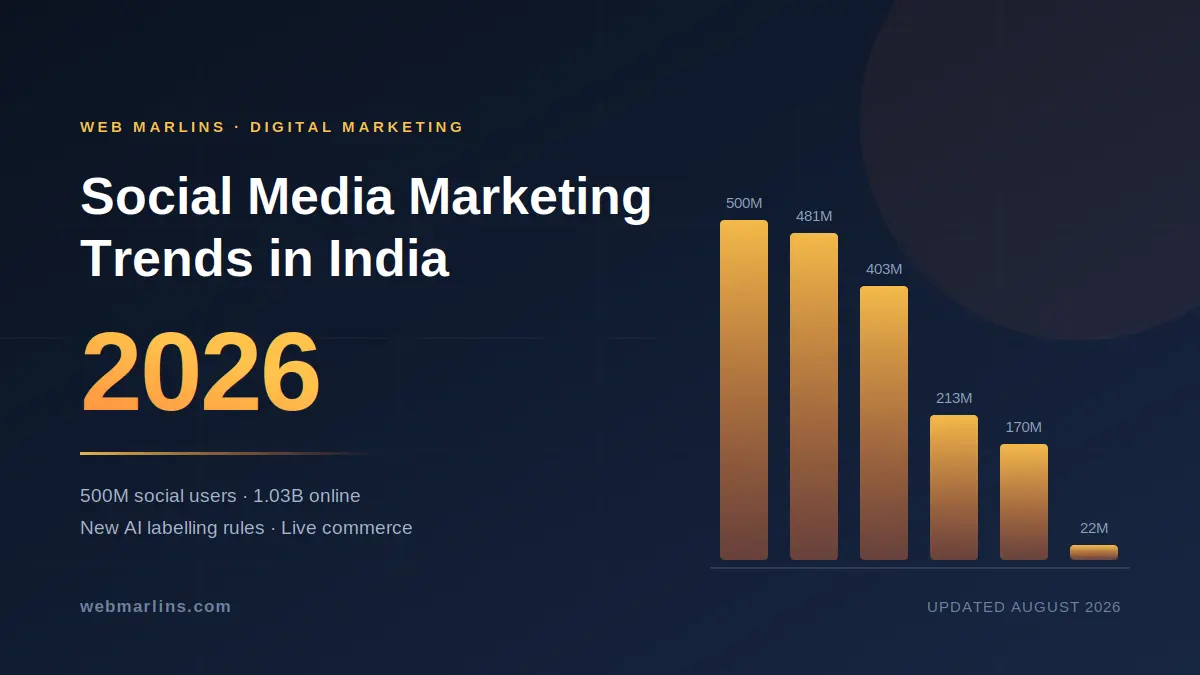
| Platform | India ad reach | Year-on-year change |
|---|---|---|
| YouTube | 500 million | +1.8% |
| 481 million | +22.9% | |
| 403 million | +8.1% | |
| Snapchat | 213 million | +4.1% |
| 170 million (registered members) | +21.4% | |
| Messenger | 108 million | +0.5% |
| 30.8 million | +235% | |
| Threads | 26.6 million | — |
| X | 22.2 million | −12.3% |
Instagram added 89.5 million to its Indian ad reach in twelve months — the largest absolute gain of any platform in the market, and a 22.9% increase. At 481 million it now reaches nearly as many Indians as YouTube.
It remains the default B2C platform and the primary home of India’s creator economy. Reels carry the distribution; Stories carry the community; broadcast channels are the underused retention tool.
403 million and growing 8.1% year-on-year. Facebook is not dying in India, and writing it off is a metro bias that costs brands reach. Its Indian audience skews older, more male and considerably more Tier 2 and Tier 3 than Instagram’s. For FMCG, agriculture, automotive, financial services and regional retail, it frequently outperforms Instagram on cost per acquisition.
YouTube
At 500 million, YouTube’s Indian ad reach is equal to the country’s entire social media user base. Growth has slowed to 1.8% simply because there is almost no headroom left — YouTube has effectively saturated the connected Indian population.
The opportunity is no longer reach. It is Shorts distribution, connected-TV consumption, and YouTube Shopping, which has been closing the gap with Instagram on shoppability.
Related: How to do YouTube SEO for your channel
170 million registered members in India, up 21.4% — among the fastest growth rates of any platform in the market.
One caveat matters: LinkedIn publishes total registered members rather than monthly active users, so this number is not directly comparable with the others in the table, and a meaningful share of those accounts are dormant. Even discounted, the growth rate indicates the Indian professional audience is broadening well beyond senior urban managers.
For B2B, LinkedIn remains the only serious paid option in India. Thought leadership content, native video and conversation-led outreach continue to outperform gated-asset lead generation.
Snapchat — the platform Indian brands keep ignoring
213 million ad reach, nearly ten times X’s, and almost entirely absent from Indian brand media plans.
Snapchat’s Indian audience is young, increasingly Tier 2 and Tier 3, and reachable at CPMs that metro-focused planners would find surprising. If your target audience is under 25, the absence of Snapchat from your plan is now harder to defend than its presence would be.
X
22.2 million ad reach, down 12.3% year-on-year — roughly 1.5% of the Indian population.
X still matters for news cycles, journalist and analyst outreach, crisis communication and real-time brand conversation. It is not a scaled paid acquisition channel in India, and budgets should reflect that. Treat it as a PR and reputation surface rather than a performance one.
ShareChat and Moj
The vernacular incumbent, and the most credible Indian-owned platform at scale. Parent company Mohalla Tech markets a combined 325 million+ monthly reach to advertisers; Bloomberg reported in July 2026 that ShareChat and Moj together have about 150 million monthly active users. Use the higher figure to understand the pitch and the lower one to build the plan.
Roughly 63% of the platforms’ users come from Tier 2 and Tier 3 cities, and content runs across 15+ Indian languages.
The important development for planners: ShareChat turned operationally profitable in the first quarter of the financial year beginning April 2026 and is targeting a $400 million IPO within four to five quarters. After several years of layoffs and funding uncertainty, the platform is now a defensible long-term commitment for Bharat-focused brands rather than a risk.
Threads and Reddit
Both small in absolute terms — 26.6 million and 30.8 million respectively — but Reddit’s reported ad reach grew sharply over the year, driven in part by its increasing visibility in Google and AI search results. For brands in technology, gaming, finance and travel, Reddit is now worth monitoring for reputation reasons even if it does not warrant paid spend.
A note on Koo
Koo — the homegrown microblogging app once positioned as India’s answer to X — shut down in July 2024 after acquisition talks with Dailyhunt collapsed. It should not appear in any 2026 media plan.
It is worth remembering as a case study, though. Koo had multilingual positioning, government endorsement, 60 million downloads and a valuation approaching $300 million, and none of it produced unit economics that survived the funding winter. Platform loyalty in India follows content supply, not national origin.
For the same reason, TikTok remains banned in India — as it has been since June 2020 — and any content or creative still referencing it is six years out of date.
Your 2026 Compliance Checklist
The practical list most trend articles leave out:
- Audit your AI-generated creative. Maintain a record of which assets are synthetic, and make sure disclosure labels survive resizing, cropping and re-export.
- Update creator contracts. Require creators to declare AI-generated or AI-modified content and to complete platform declaration prompts correctly.
- Know the takedown clock. Flagged unlawful content now carries a three-hour removal window. Your brand-safety escalation path needs to move faster than it did in 2025.
- Layer your disclosures. ASCI paid-partnership labelling and IT Rules AI labelling are separate obligations. Sponsored content containing AI elements needs both.
- Review consent for first-party data before building lookalike or custom audiences under India’s data protection framework.
- Check regional creative for compliance, not just translation. Disclosure labels need to be legible in the language the content is published in.
How Web Marlins Helps Brands Adapt
Awareness of trends is cheap. Execution against them is not. Here is how we work with brands navigating this shift:
Short-form and micro-drama production. We build platform-native content for Reels, Shorts and Moj — recurring series formats designed for repeat viewing and algorithmic recognition, not disposable one-off clips.
AI-assisted creative with compliance built in. We use AI across personalisation, predictive targeting and creative variation, with disclosure and provenance handling built into the workflow rather than bolted on after a takedown notice.
Performance-linked creator programmes. We connect brands with regional creators across Tier 2 and Tier 3 markets and structure agreements around measurable outcomes, with attribution configured before launch.
Vernacular strategy. Content built for regional audiences rather than translated at them, across India’s major language markets.
Social commerce and live selling. Shoppable video, affiliate structures and live commerce sessions designed as a complete funnel from discovery through checkout.
LinkedIn and B2B. Thought leadership, native video and lead generation for the fastest-growing professional audience in the country.
We also offer SEO, PPC, content writing, web design, website development and local SEO services.
Further reading: Google Search Console now tracks Instagram, X and YouTube performance · What is Generative Engine Optimization?
Conclusion
The headline story of Indian social media in 2026 is not a new platform or a new format. It is that the market matured in three directions simultaneously.
Audience growth slowed sharply even as internet adoption accelerated, which means acquisition is getting more expensive and retention is getting more valuable. Creator spend became accountable to performance, which means follower counts stopped being a currency. And AI content became a regulated category, which means creative workflows now carry compliance requirements they did not have a year ago.
None of that is bad news. It is the ordinary process of a channel growing up. The brands that will do well over the next eighteen months are the ones that treat social as rented, measured and compliance-aware — rather than as the free reach machine it briefly was.
Frequently Asked Questions
What are the biggest social media marketing trends in India in 2026?
Short-form video maturing into commerce, including the rise of vertical micro-drama; regulated AI content following MeitY’s February 2026 labelling rules; the formalisation of the creator economy around performance-linked pay; vernacular expansion into newly connected audiences; live commerce; and a shift toward brand-owned communities as organic reach compresses.
How many social media users does India have in 2026?
India had 500 million social media user identities as of October 2025, equal to 34.1% of the population, alongside 1.03 billion internet users at 70% penetration, according to DataReportal’s Digital 2026: India report. Notably, social media identities grew only 1.8% year-on-year while internet users grew 27.7%.
What are India’s new AI content labelling rules?
MeitY notified the Information Technology (Intermediary Guidelines and Digital Media Ethics Code) Amendment Rules, 2026 on 10 February 2026, effective 20 February 2026. They require AI-generated content — legally termed “synthetically generated information” — to be prominently labelled, to carry provenance metadata where technically feasible, and to be declared by users before publishing. Flagged unlawful content must be removed within three hours, and as little as two hours for non-consensual deepfake material.
Do these AI rules apply to brands and agencies, or only to platforms?
The formal legal obligations fall on intermediaries — the platforms. But brands and agencies bear the practical consequences: content removal, wasted production spend and reputational damage. In practice, any brand running AI-assisted creative at scale in India needs a documented labelling process and creator contracts that require disclosure.
Why are short-form video trends in India so important?
Short-form video is now the default consumption format across YouTube Shorts, Instagram Reels and Moj, and it has become a commerce surface rather than purely a discovery one. The newer development is micro-drama — serialised vertical fiction — which ShareChat alone serves to roughly 65 million monthly viewers, with more than 700 million episodes watched daily.
Which social media platforms should Indian brands focus on in 2026?
Instagram (481 million) and YouTube (500 million) for reach; Facebook (403 million) for Tier 2 and Tier 3 and older audiences; Snapchat (213 million) for under-25s, which most Indian brands under-use; LinkedIn (170 million registered members) for B2B; and ShareChat and Moj for regional-language audiences. X has under 23 million ad reach in India and is declining year-on-year — treat it as a PR channel rather than a paid one.
Is influencer marketing still worth it in India?
Yes, but the model has changed. India’s influencer marketing sector is estimated at ₹3,000–3,500 crore in 2025 and projected to reach ₹4,500–5,000 crore by 2027, growing at 22% a year. The brands seeing returns are those paying on performance, working with regional micro and nano creators, and configuring attribution before campaigns launch rather than reconstructing it afterwards.
How is LinkedIn growing as a marketing channel in India?
LinkedIn reported 170 million registered members in India in late 2025, up 21.4% year-on-year — among the fastest growth of any major platform in the market. The figure counts registered members rather than monthly active users, so it overstates active audience, but the growth trajectory indicates the professional audience is broadening well beyond senior urban roles.
What happened to Koo?
Koo, the Indian microblogging platform positioned as an alternative to X, shut down in July 2024 after acquisition talks with Dailyhunt fell through and funding could not be secured. It should not be included in any current media plan.
How can Web Marlins help my business adapt to these trends?
We build platform-native short-form content, performance-accountable creator programmes, vernacular campaigns and social commerce funnels for Indian brands — with AI disclosure and compliance handled as part of the workflow rather than as an afterthought. Get in touch.
Sources: DataReportal / Kepios, Digital 2026: India (November 2025), incorporating data from ITU, GSMA Intelligence, Ookla and platform advertising tools; MeitY, Information Technology (Intermediary Guidelines and Digital Media Ethics Code) Amendment Rules, 2026; Kofluence, Decoding Influence: Annual Research Report 2026; Bloomberg and Business Standard reporting on Mohalla Tech, July 2026; Lumikai.

Amir Siddiqui is a Digital Marketing Expert and SEO Specialist with over 8 years of experience helping businesses grow through data-driven digital marketing strategies. As the Founder of Web Marlins Pvt. Ltd., his core expertise lies in Search Engine Optimization (SEO), including Technical SEO, Local SEO, AI SEO, and content strategy. He has helped businesses across India, the USA, and the UAE improve search rankings, increase organic traffic, and generate high-quality leads through sustainable, results-focused SEO solutions.